Should you believe in climate change?
"This is very hard for scientists to understand. The scientific evidence that humanity is having an effect on the climate is overwhelming and increasing every year. Yet public perception of this is confused."
http://www.guardian.co.uk/environment/2012/mar/23/climate-change-believe-in-itYou don't have to believe in the ocean, but if you jump in it, you're going to get wet.
I believe for every drop of rain that falls...
what foot said.
I believe for every drop of rain that falls...
An extremist talk show host recently interviewed an MBA who counts raindrops. By reporting those counts on his spread sheets, he proved global cooling is now happening.
You too can count rain drops to prove scientists are wrong. As Costello said, "What do they know."
:lol:
Or as Kim Basinger once infamously said: Neil Simon? What does he know about comedy?"
Or you can just walk between the raindrops.
[YOUTUBE]c5LSRrAwUtA[/YOUTUBE]
a number of possible contributory factors: the move from being a science issue to a political issue may have introduced more distrust
This is one of the things I find most shocking.
I expect that in 50-100 years plus, those deriding the facts of climate change will look at ridiculous as the opponents of Darwin.
Oh, wait.
There are nutjobs out there who don't accept evolution to the extent they will not allow it to be taught to children. Still, at least they never qualify medically, due to their inability to grasp facts.
Oh, wait.
Sigh.
I'm sorry, I've devoted my time to believing in Unicorns, Dragons, and Fairies. Don't have room for Climate Change.
Really? I think the dragons are mostly to blame.
It is amazing that the evidence for climate change and mans impact on the climate is overwhelming, yet there seems to be people who can argue the fact. I work with lots of guys who are staunch republicans and will argue that climate change is on a natural curve and mans impact is minimal.
I have a new project for myself though, I want to find out how many tons of waste products are put into the atmosphere by man made stuff, autos, planes, factories, homes etc...and put that into terms of how many volcanoes would have to erupt per week to match that output per week.
...
I have a new project for myself though, I want to find out how many tons of waste products are put into the atmosphere by man made stuff, autos, planes, factories, homes etc...and put that into terms of how many volcanoes would have to erupt per week to match that output per week.
For electrical generation in the US, you can start with
EPA's eGrid.
Of course, that's a limited sub-set of all the man-made emissions from all sources, and from around the world.
A good article on the combined effect of
climate change and peak oil.
I have a new project for myself though, I want to find out how many tons of waste products are put into the atmosphere by man made stuff, autos, planes, factories, homes etc...and put that into terms of how many volcanoes would have to erupt per week to match that output per week.
I tried doing this myself a few years ago and posted the results
here in the Cellar.
volcanoes produce approximately 200 million tonnes of CO2 per year, while mankind produces about 26.8 billion tonnes (in 2003.) Even the largest eruption in recent times, Pinatubo in the Philippines, produced between 42 and 234 million tons of CO2. (1, 2) so even that year, volcanoes didn't come anywhere near producing the CO2 that mankind did.
"This is very hard for scientists to understand. The scientific evidence that humanity is having an effect on the climate is overwhelming and increasing every year. Yet public perception of this is confused."
http://www.guardian.co.uk/environment/2012/mar/23/climate-change-believe-in-it
I believe it now, but the political argument was being forcefully made well before the evidence was in by folks with a preference for command economies. That is what caused the perception that it wasn't good science and what needs to be overcome now.
I think part of the problem is that they initially used the term global warming, instead of climate change.
IMO, if you don't believe in climate change, you are a moron.
But even if you don't, even a moron has to know that the use of fossil fuels and chemicals in plastics, etc. as well as garbage and waste disposal is not GOOD for the planet.
Please to define good for the planet.
Please to define good for the planet.
Being in orbit around the sun, clearing the neighborhood of hoodlum asteroids wearing hoodies, sufficient mass to keep it fairly round, not acting like Pluto.
Those are all things that are good for planets.
Planets. Ask for them by name.
Being in orbit around the sun, clearing the neighborhood of hoodlum asteroids wearing hoodies, sufficient mass to keep it fairly round, not acting like Pluto.
Those are all things that are good for planets.
Planets. Ask for them by name.
Bright aurora borealis and hoodies [tails] on comets,
Size to shape ratios and planetary status,
Celestial objects that are called by their names,
These are a few of my favorite things. ;)
Never doubted it was happening, just couldn't get good answers to, so what?
One side said it didn't matter, while the other side said the sky was falling. I knew neither was true, but I still don't know how far, how fast, what are the consequences, and can we do anything about it.
I know if all the polar bears die, that's a shame but it won't affect me very much. However, if the glaciers are gone that supply a quarter of the world's population with fresh water, that might.
I think the thing to worry about is not the big critters, but the small ones. You know the old food bacteria saying, "Life begins at 40?" as in 40 degrees? Notice how it isn't 39 degrees or 41 degrees?
At certain temps life is kept in check, a quarter of a degree and the scales are tipped in favor of exponential growth. Just ask any home brewer.
It's the things we aren't aware of that we should be concerned with. Fuck the polar bears, per se.
One side said it didn't matter, while the other side said the sky was falling.
Too many wacko political types were preaching for self serving power purposes.
Meanwhile, those who actually know this stuff have been saying the same all along. The problem is created by man. We do not yet have all details. We do not know how severe this problem may become. But we do know what is created today may generate consequences twenty, fifty, or 100 years from now.
Does the ozone problem still exist? Of course. But its consequences are slowly being solved. So political hypsters are no longer perverting those facts, creating confusion, or making denials. They cannot obtain power by hyping spin and lies about ozone depletion.
Is mankind changing the climate? Of course. Confirmed consequences will not be known for decades. Maybe minor. Maybe not. But those consequences will be significant.
For example, to deal with is known, NYC is already making infrastructure plans. Because cities must plan and do now for what is needed 20 or more years later.
Unanswered questions remain how severe its consequences will be. We explore all worst case scenarios to define an answer somewhere inside those extremes. Unfortunately wacko political types must hype those extremes into hate, fear, and confusion. Rather than learn why those extremes are defined.
We know the problem exists. Finding numbers to quantify the problem is the unknown part. Meanwhile those with self serving agendas, little education, and a need for power are the 'sides' that too many entertain (hear) rather than learn the science.
Problem with such a subject is that it is so charged politically. My own opinion would probably make an ecologist go up in flames but here it goes :
We're not the cause of global warming.
Most probably it is a phase our planet goes through.
We're just accelerating it.
You'll remark that I do not deny the climate is changing. Yet, a lot of people would think so.
Sure, we should do something to at least minimize our impact in this. But we're going at it without thinking clearly.
All of us have to change our manner of thinking. And you can not make it happens by issueing laws.
I don't know the situation in other countries but, here in France, wind power is all the rage. Since Brittany is a windy place, there are wind farms projects nearly everywhere. Personally, I don't have a thing against wind farms if the project is about producing energy not making a political coup.
Did I mention that Brittany is windy? It is windy enough that for nearly a quarter of the year we have winds in excess of 55 mph... the cut-out speed of a Nordex N80/2500 a typical windmill model.
Solar power is still in its infancy. In France, it was sustainable because you could receive state subsidies.
Hydro power? While our potential for huge dams is probably at full capacity, we could use microhydro to generate power. Around home, I know of at least 15 former watermills that could be equipped. Systems are well known, low maintenance and have relatively low installation costs... but when you try to come up with a project, the ecologists begin crying for the fish. Most of these places have been mills for decades, if not centuries, so the river ecosystem is running OK.
They want us to make use of public transportation. Again, no problem to do that, at least on my part. I even tried it recently when I took a 3 months job in Brest. Train station : a 5 mn walk from home. First morning train : 6:52. Second and Last morning train 7:52. No angst there.
Transit Time by train : over 45 mn (station to station) (add 15 mn walking)
Transit time by car : a little less than 30 mn (door to door) (no walking)
Last evening train : 17:24 (I worked from 8:30 to 18:00)
And it is not going to change.
Sorry for my rants but it had to get out... and don't get me started on our farmers.
What about your farmers??
We're not the cause of global warming.
Most probably it is a phase our planet goes through.
We're just accelerating it.
And if that acceleration is significant enough in itself, it makes sense to slow it down. I know that I will die eventually, but I would certainly like to put it off.
A lot of the fish we now eat is now poisoned. Logically, one would think that if most of the earth's surface is water, that it would take a lot to pollute the ocean.
But in reality, that amount is still finite.
Even at 332.5 million cubic miles, we're talking about an 860 mile globe of water if it was removed from the surface. It doesn't take as much pollution to affect something like that over decades, especially as technology advances and with it increasing pollution and more exotic toxins.
So the earth is big, but the surface of the earth really isn't compared to the mass of the planet. And affecting what is essentially a skin extending up a few miles into the air and a few miles into the ocean is not that difficult. We already do this on a small scale with cities covered in asphalt and concrete that trap heat, something that is being looked at and corrected in some places.
In the last decade we have given up a lot of money and some freedom to keep us safe from the possibility of a terrorist attack that might kill hundreds or even thousands. How much effort should we put into dealing with the possibility of a global problem that can kill millions?
We're not the cause of global warming.
Most probably it is a phase our planet goes through.
We're just accelerating it.
Very nearly correct, IMHO. Let me change a few things ...
We're not
the cause of global warming.
[strike]Most probably[/strike] it is a phase our planet goes through.
We're [strike]just[/strike] accelerating it.
Climate has been unstable for around five million years, due to either the Panamanian land bridge separating the Pacific and Indian Oceans, the Himalayas being thrust up preventing the monsoons from reaching into North Asia, or both. Since then we've been swinging between glacial and inter-glacial ages.
Our activities - including what we put into the atmosphere, and widespread changes of land use and cover - will change climate in ways it would not otherwise have changed.
Now for my climate heretic moment ...
If we did
not alter the atmosphere with greenhouse gases, ti is nearly certain that sometime in the next couple of tens of thousands of years, the Earth would return to glacial conditions. For human purposes, that would be
bad.
[/heretic]
But if we overdo the greenhouse gases, we over-warm the planet, and push through a whole bunch of other changes, most notably shifting weather patterns and sea level rise. Given that our whole infrastructure is set up for things as they are today, significant change to climate is also bad for human interests.
[handwringer] ... but I also think that climate change won't really start to bite us on the arse for 50 to 100 years, and serious sea level rise will take several times longer, and we'll have screwed ourselves up with simple resource depletion (soil, water, fish, forests) and pollution long before then, so although I believe we are fooling with the climate, we have more urgent things to worry about. [/HW]
So, how about that celebrity gossip and sporting scandal, eh?
... but I also think that climate change won't really start to bite us on the arse for 50 to 100 years
I don't know about that. We're seeing stronger storms, more tornadoes, loss of snow pack causing drought, more insects and insect borne disease.
Some of these might be cyclical, related to El Nino or other recurring patterns, but some may be man made. I'm personally not happy with an almost year round allergy season.
True, but I consider those irritants on the level of a mosquito-bite.
By "bite us on the arse" I was thinking of catastrophic flooding that forces the permanent evacuation of tens of millions of people from places like Shanghai, Dhaka, New York, and London, or permanent shifting of rainfall areas forcing he abandonment of huge tracts of farmland, leading to famines that kill huge numbers. Real arse-biting stuff.
But relax, that's at least 50 years in the future! :D
*shrug* Been warming since 1830 and no cities abandoned for it yet.
I almost put this into a thread for it's lyrical writing, but it is really
a technical piece about climate change and mankind's effect on the planet.
The long quote below struck my emotional strings.
NY Times
8/17/13
Gorgeous Glimpses of Calamity
<snip>
There’s a dispassionate quality to the view from on high.
On Aug. 2, 2005, the circuitous trajectory of Messenger, a NASA spacecraft,
brought it boomeranging back toward Earth on its way to explore Mercury.
Its steady stream of data offered a rare chance to watch our world grow larger in space,
as a visitor from another star system might first see it.
Initially, Earth was simply a pearl of milky white and ultramarine blue,
with the white — clouds, ice and snow — being other forms of life-giving water.
Eventually, hues of tawny gold appeared; more than a third of the visible land area, it seemed, was desert.
Only later, when the planet filled half the picture plane, did a hint of emerald emerge between the clouds.
A verdant, compelling green. The color of photosynthesis.
After this first direct evidence of life on Earth, and with the spacecraft
still a quarter of the distance to the Moon, another hue emerged.
Above the lush equatorial belt of South America, lower in altitude and distinct from the clouds,
it was a nebulous, smoky, profoundly unsettling gray-blue.
Could this be from fires, perhaps willfully set?
Could this first hint of intelligent life on Earth signify a species evidently busy creating still more desert?
<snip>
And this was the view from some 65,000 miles away.
Far closer in, NASA maintains a small fleet of Earth-observing satellites.
Unfortunately, their visual record makes it even clearer that something is going badly wrong in the garden.
Across the world, tremendous wildfires can be seen raging during the searing summers of the new millennium.
As the oceans warm, vast equatorial hurricanes have smashed North America.
In Canada, the Northwest Passage has twice become clear of ice during the last decade.
And the smog is no longer localized.
A gunmetal exhalation of coal and fuel smoke blankets China almost daily,
extending out across the sea toward the Korean Peninsula,
Japan and beyond.
We are tracking glaciers retreating, and immense polar icebergs calving into rising waters.
Gargantuan sandstorms extend out from expanding deserts, sometimes traversing the breadth of the Atlantic.
<snip>
There are several still images from space and a few videos in the article.
Here is just one of the
embedded videos:
June 2013: Dense clouds of smoke from fires set on the Indonesian island of Sumatra choked neighboring Singapore.
This 6' 1" Governor seems to think he can keep his head above water by censuring Florida's vocabulary.
Ravaged by climate change, Florida reportedly bans term ‘climate change’
Washington Post - errence McCoy - 3/9/15
...the state of Republican Gov. Rick Scott, who has punted on the issue.
“Well, I’m not a scientist,” he told the Miami Herald’s Marc Caputo last year
when asked if he was becoming less skeptical of man-made climate change.
According to a Sunday report from the Florida Center for Investigative Reporting,
Scott’s aversion to discussions of man-made climate change has been brought to bear
on a department charged with protecting a state that already exhibits many of the changes
scientists predict will overtake other coastal regions.
Officials with the Florida Department of Environmental Protection (DEP),
reported writer Tristram Korten, have been restricted from using the term
“climate change” or “global warming” in official correspondence.
The investigative reporting outfit called it an “unwritten policy,” which was
“distributed verbally statewide” and has “affected” how one of the largest departments
in the state, armed with a $1.4 billion budget and 3,200 employees, does business.
“The irony is clearly apparent,” Korten told The Washington Post on Sunday night.
“Florida is a peninsula with 1,200 miles of coastline, and when it comes to climate change,
we’re the canary in the coalmine.
And we’re relying on the state government to protect us and to plan for these changes.”
What utter bull shite. Is there such a thing a perpetual motion?....Well, I'm not a scientist, so I don't think I can really answer such a question.....Oh, my fucking God I hate politicians. Problem is that the American people who elect these clowns are so fickle that he has to lie to keep his job and get re-elected. So, basically we are all just lying to ourselves to make money. At least the majority of the minority who vote.
Yes I believe in change. Last week was below freezing for a few days. Now about 70 and rain. Next week who knows?
What utter bull shite. Is there such a thing a perpetual motion?....Well, I'm not a scientist, so I don't think I can really answer such a question.....Oh, my fucking God I hate politicians. Problem is that the American people who elect these clowns are so fickle that he has to lie to keep his job and get re-elected. So, basically we are all just lying to ourselves to make money. At least the majority of the minority who vote.
True words.
Yes I believe in change. Last week was below freezing for a few days. Now about 70 and rain. Next week who knows?
Can the people of NY sell you a hurricane called Sandy? Consider it a fire sale.
Yes I believe in change. Last week was below freezing for a few days. Now about 70 and rain. Next week who knows?
You have just described Scottish normal weather, we can get the 4 seasons in an hour here :eek:
I love how some folks will point to one thing and be like, "This sure doesn't seem like global warming to me!" with some asinine self-righteous chuckle.
As someone that is a big fan of science (and also has a Master of Science degree), the amount of anti-science craziness that goes on these days scares the crap out of me.
... the amount of anti-science craziness that goes on these days scares the crap out of me.
That's OK. It's those craziness genes that keep the gene pool strong.
Climate science literacy unrelated to public acceptance of human-caused global warming
Deep public divisions over climate change are unrelated to differences in how well ordinary citizens understand scientific evidence on global warming. Indeed, members of the public who score the highest on a climate-science literacy test are the most politically polarized on whether human activity is causing global temperatures to rise.
The headline is backed up by a scientific study, operated by a top university, and published in a peer-reviewed scientific journal.
So now, if you believe that the people who do not believe as you do are uneducated in science, uninformed, stupid, or just plain crazy, you are...
a science denier.
Well, it argues against "uneducated in science", "uninformed", and "stupid", at least.
But knowing all the science and still denying what the scientists overwhelmingly say? Is that better or worse than simply being uninformed?
[strike]What do the scientists overwhelmingly say?
ETA that's three part question
What do they say?
Who are the scientists?
What is overwhelmingly?[/strike]
That's all wrong. Let me figure out the right question.
Does "climate change" = "climate warming" ?
Is the overall global climate: warming, cooling, or staying the same ?
Are the activities of mankind: contributing, causing, or having no effect ?
It's all in how you ask "the" question.
Roughly speaking, I believe in AGW.
I hate hate hate unscientific statements about AGW. Hate.
I hear them mostly from those who believe in it.
After an hour of trying, and three deleted novellas, I can't formulate the question. I guess I don't really want to. Enjoy yourselves.
Roughly speaking, I believe in AGW.
I hate hate hate unscientific statements about AGW. Hate.
It's rather unfair to be pissy about people making mistakes, considering there's a lot of misinformation about how to calculate and when you must use Actual gold Weight.
I hear them mostly from those who believe in it.
After an hour of trying, and three deleted novellas, I can't formulate the question. I guess I don't really want to. Enjoy yourselves.
Oh wait, do you mean Anthropogenic Global Warming?
If you're going to rise to the four hate per sentence level of passion on this, that must mean you're pretty good at detecting unscientific statements. Do your judge them on whether or not the speaker understands the basic thread of what they are trying to express in lay language?
Or do you use the monocled Professor approach, that they better be able to express, in proper scientific jargon, the exact results which have been reviewed and approved by the International Brotherhood of Unstained Executive Lab Coats?
There's nothing I like better than a good self-righteous dressing down of people who are wrong, but I find the world has gotten so complicated it's awfully hard for me to determine whether they're wrong or not. How did the black and white world get polluted with all these shades of grey?
The scientists have produced a shitload of knowledge in my lifetime, as well as stuff like a zillion chemical compounds I'd rather not think about. They'd make a "breakthrough", popular science would completely distort what it is and how it will affect the whole human race. These came so fast and proved to be only semi reliable, so if it didn't affect work, I'll just wait for the flying cars.
But it nagged me, half the time it's new knowledge, but the other half they'd say, "up until now scientists thought", or "this disproves what science have believed". Yesterday this was solid scientific fact, plan space shots, plan my health care, get four hate per sentence irate on it... today, fugetaboutit.
Whoopee! We're all gonna die.
Roughly speaking, I believe in AGW.
Presumably because you recognize that scientists overwhelmingly say it is happening? You're not a climate scientist yourself, so you have to defer to the experts.
I hate hate hate unscientific statements about AGW. Hate.
The phrase "what the scientists overwhelmingly say" may not be worded with mathematical precision, but no matter how many subquestions you divide it into, you know what it means, and you know that "what the scientists overwhelmingly say" is that AGW is real.
Ok.
Who do you trust as a reliable source of information on this subject?
No I don't. Convince me.
Of what? You already believe AGW is real. Did you come by that belief independently of scientists warning us of it?
Convince me that "what the scientists overwhelmingly say" is that AGW is real. I am not yet convinced of that.
Maybe this will help?
http://iopscience.iop.org/1748-9326/8/2/024024/article
ABSTRACT:
We analyze the evolution of the scientific consensus on anthropogenic global warming (AGW) in the peer-reviewed scientific literature, examining 11 944 climate abstracts from 1991–2011 matching the topics 'global climate change' or 'global warming'. We find that 66.4% of abstracts expressed no position on AGW, 32.6% endorsed AGW, 0.7% rejected AGW and 0.3% were uncertain about the cause of global warming. Among abstracts expressing a position on AGW, 97.1% endorsed the consensus position that humans are causing global warming. In a second phase of this study, we invited authors to rate their own papers. Compared to abstract ratings, a smaller percentage of self-rated papers expressed no position on AGW (35.5%). Among self-rated papers expressing a position on AGW, 97.2% endorsed the consensus. For both abstract ratings and authors' self-ratings, the percentage of endorsements among papers expressing a position on AGW marginally increased over time. Our analysis indicates that the number of papers rejecting the consensus on AGW is a vanishingly small proportion of the published research.
Who paid for those? just curious if there was a financial incentive for their conclusions.
Well done, I was expecting either that, or the 2004 Science editorial. This is a stronger piece IMO.
What do you think of the major criticisms of this study?
Who paid for those? just curious if there was a financial incentive for their conclusions.
It's a literature review, no money required.
for the abstracts or for the review? or both?
Plus, see the
wiki page of counterexamples. First, it's a short list, though of course, it is undoubtedly incomplete. Second, it contains multiple references to what the scientific consensus
is that they are objecting to, including especially
another wiki page specifically listing a large number of statements of consensus on the subject. That page includes this statement:
As of 2007, when the American Association of Petroleum Geologists released a revised statement, no scientific body of national or international standing rejected the findings of human-induced effects on climate change.
Of course, that revised statement is somewhat equivocal, but they had been the last holdout (as a group; there are individuals, as mentioned in the first link) who been explicitly denying AGW.
Oh, of the abstracts 1991-2011, those were mostly paid for. The review is free. But given the scope of all academia I really doubt that who paid for the studies is important. If we're talking about one study that's one thing, this is a review of many many studies and the money is mostly from academia I'd expect.
If we want to be careful, Wikipedia is out, right? We should agree on that.
My line of question was because I wondered if many of the abstracts were paid for by a small number of "entities" As you were.
If we want to be careful, Wikipedia is out, right? We should agree on that.
The pages I linked were lists of non-Wikipedia references.
Not following you. The bottom of every Wikipedia page is a list of non-Wikipedia references.
The top of these particular wikipedia pages (especially the second one) is mostly a blurb about what you will find in the links at the bottom.
Oh now I get it; sorry, being dense;
Who are the scientists? The population of all scientists.
What do they say? They agree with IPCC 2001.
What is overwhelmingly? Implied, because there aren't many of the population of all scientsts on the disagreement page in Wikipedia.
Also, according to Wikipedia, when scientific organizations make statements, they never make a statement against AGW. Okay, would such a statement require a simple majority vote, or... an overwhelming majority vote?
HM, assuming this was any other topic, would you be convinced? I am not convinced.
More specific quibbles:
We're out of sync already... what I was thinking by "AGW" is this:
[INDENT]1) everything we got says it got 0.6 degrees C warmer in the last 134 years
2) mankind's introduction of some gases is definitely responsible for this[/INDENT]
(And that's what I "roughly speaking" believe.)
But what the 2001 IPCC statement says is this:
[INDENT]1) everything we got says it got 0.6 degrees C warmer in the last 120 years, and most of that in the last few decades
2) mankind's introduction of CO2 and methane are almost definitely responsible for this
3) between 1990 and 2100, global temp will rise between 1.4 and 5.8 degrees C[/INDENT]
I think we can resolve our differences on #1 and 2. What do you think about #3. Shall we just throw it out?
The IPCC did. In 2013 their predictions section, a far cry from the front page already, contains this item:
[INDENT]The global surface temperature increase by the end of the 21st century is likely to exceed 1.5 °C relative to the 1850 to 1900 period[/INDENT]
Likely to = 66-90% probability.
You know why they walked back. Let's not say the word.
So, roughly speaking, the 2013 IPCC statement does not agree with the scientific consensus, as stated in the 2001 IPCC statement.
I suppose we could add them to the list of deniers. But in some sense of all this, fuck the IPCC. It's a group of people, chosen in a political manner, by a political organization, and working by committee. They are building political consensus, not scientific consensus.
HM, assuming this was any other topic, would you be convinced? I am not convinced.
Most other scientific topics don't have major industries trying to sow doubt in them, so it wouldn't come up. But yeah, if every major medical group said vaccines were safe and effective, and even ones funded and populated by anti-vaxxers said "well, maybe", I'd find that pretty convincing.
Actually, a better example might be smoking and lung cancer. When even the studies funded by the tobacco companies had to stop denying the connection, that was an overwhelming consensus.
The IPCC did. In 2013 their predictions section contains this item:[INDENT]The global surface temperature increase by the end of the 21st century is likely to exceed 1.5 °C relative to the 1850 to 1900 period[/INDENT]You know why they walked back. Let's not say the word.
They raised, but softened the lower prediction, and removed the upper limit. On the whole, that's a bit of a "walk back", but not much. I don't consider it a weakness of science, though, when predictions change in the course of a decade, and the softening of the language probably results in a bigger consensus.
But in some sense of all this, fuck the IPCC. It's a group of people, chosen in a political manner, by a political organization, and working by committee. They are building political consensus, not scientific consensus.
As with evolution and vaccines, politics is where most of the debate (as opposed to research) on the issue is taking place. What you say may be true of the IPCC, but all they did was codify what they thought the consensus was, ask actual scientific organizations if they concurred, and present the results to governments. The second part of that is relevant to the discussion.
Politics is where the consensus is really built, and there's where my hate hate comes from. The argument stops being scientific and starts being political.
At that point, the facts collections start to differ, and meta-facts show up. Example.
NASA reports there is a 38% probability 2014 was the warmest year on record.
The orange team takes home: 2014 was the warmest year ever.
The purple team takes home: NASA can't say what the warmest year is.
Both are wrong, but they carry their validating meta-facts back to their hives and add it to their bullshit stew. Everybody's eating it and convinced they are correct and have unlocked the special secret sauce. There is NOTHING in the world as satisfying as being RIGHT.
Sometimes one team even takes a detailed look at the other team's meta-facts and.... guess what, their information is all wrong! More proof our team is right!
But now, a study shows that the orange and purple teams are equally well-informed and scientifically literate. What! Impossible!
The meta-fact from the 2013 literature review is 97% of scientists agree with AGW. That's not what the study says. What the study says is much less convincing, certainly not overwhelming, in my opinion*. But 97%, THAT is impressive... add it to the stew.
*forming your own opinion is left as an exercise for the reader or you could just take a nap because wtf is all this shit anyway
You say Orange and Purple are both wrong. I don't think either are wrong, although they are another brick in the wall. They can elicit anger, like all slogans, bumper stickers, headlines, because they're impossible to counter without more information than most people want to hear.
Any official statement from the IPCC, NASA, AMA, UN, Vatican, Kremlin, et al, is position, not explanation. I think it's safe to assume there is always politics, power struggles, self interest, and dozens of unknowns, behind it. But isn't that what we really need to know, the position of the power players?
I try to keep in mind I'm not a leader, I'm a follower. As much as I try to stay informed, understand what's behind the curtain, and pride myself on being smarter than the average bear, I know it doesn't mean shit because I have no power. I also know if I gather a band of like-thinking merry (wo)men, to fight for truth, justice, and the American way, the people with power will think it's cute. But if we cross in the middle of the block, or against the light, they'll crush us like grapes.

BO added "dangerous" to the consensus. Given what we've discussed in this thread, do you believe scientists agree on that? It wasn't included in any of the literature reviews.
Orange team meta-fact
Of course they agree with that; that's why what they've been telling us has been considered a warning. "Good news everybody, it's gonna get warmer!" wouldn't have provoked such a political backlash; Exxon could have taken credit for saving you cash on your heating bill.
The question of danger is not a scientific question, though, more of a sociopoliticical one. When climate shifts, some previously abundant areas will be less so, and some previously inhospitable ones will become less so. Unfortunately, the currently abundant areas are where the people are, and we've seen what happens when people are displaced en masse. That's where the danger to people comes.
Though, of course, many would consider danger to displaced species as well, but I would guess that' not what the tweet is referring to.
Sure, there's hyperbole on every side of every issue. That doesn't mean that every issue is halfway between the hyperbole of the extremes. So there are issues with the 97% report (did I miss discussion of those issues on the thread?); it's margin of error would have to be pretty big to get out of "overwhelming" territory.
Is there any way we can put politics aside and get to the truth of the matter?
For one of my college courses I did a little research just to get to the bottom of the question: is climate change real or not? Just to get to that question. Not whether climate change is man made or not, and we certainly can get to that as well.
One of my observations is that on the internet, and this doesn't matter if I'm using the surface net or digging a bit into the deeper net of academia, business, and government; sources that report that climate change (global warming used interchangeably here) is real are almost always reputable educational, scientific organizations, business, and government sources. Overwhelmingly, sources that refute that climate change is real are private, not affiliated with any educational, scientific, or business other than business in the fossil fuel industry, and not affiliated with government sources. Almost all of the sources that I could find refuting climate change could not be cited on a thesis paper. There certainly are sources that refute climate change is real that can be cited on a thesis, the number is ridiculously small when compared to the number of sources that can be cited that report the reality of climate change.
In the same manner, and this is what my post earlier is getting at, these guys can find about 4,000 papers that explicitly speak about AGW. Of course 66.4% of all papers published between 1991-2011, over 12,000 papers, support that climate change is real but take no explicit position on AGW. Se we are really seeing a 97% snapshot of 4,000 papers of 12,000 published. I also understand after reading a few that most scientific papers published are very narrow and focused on a specific topic, event, or set of observations. It is not a mystery to me that 32% of the 12,000 papers published explicitly talk to AGW. At the end of the day it must be noted that only,about 3% of 4,000, that's 120 to 3,880; the difference between explicit support of AGW and explicit refutation. This is significant, this isn't a 60/40 split.
Good post Joe
You were saying it's 97% of the
papers. It was really 97% of the
abstracts. But hey we can mince words on that.
"97% of the abstracts|papers in climate journals" has morphed right into "97% of scientists". Not scientists who have written papers in climate journals. Not climate scientists, or earth scientists. Just plain, scientists.
Sitting in the waiting room while my Ranger was being diagnosed, I picked up a magazine.
It was the March 2015 issue of National Geographic, and this issue is devoted
to just how people come to believe a thing is true or not.
I wondered whether it was the basis of UT thesis here on AGW, or just coincidence.
In any case, the NG articles start with "flat earth" in earlier times, and go on to:
Did NASA actually land on the moon, Do vaccinations cause autism, Is climate change real, etc....
Basically most of this NG issue is dealing with the question of why people come to believe something, or not,
... even if it is contrary to what "reputable scientists" and/or scientific methods are reporting.
I can't here give all their arguments, but they conclude some of the following:
A) Scientific "facts", by themselves, often do not convince or change the beliefs of people.
B) Scientists that become advocates tend to lose credibility.
So discrediting the "reputation of the scientist" and "who paid for the study" are often used as tactics.
C) Scientists who do become advocates usually can not later on regain their previous credibility.
D) People who don't buy what the science says tend to put their inter-personal relationships at a higher priority.
e.g. "tribal relations" outweigh "factual arguments" to the point that:
If were they to change their belief, they would be at odds with their "tribe"
... even to risking being expelled from their "tribe"
E) "trust" of the message-giver is of great importance. e.g., family members are usually more trusted.
They give one example of a daughter being unable to convince her father
... and she finally says: "If you don't believe in xxxxx, you don't trust me."
F) The issue also includes the recently publicized ideas that people
who are"scientifically informed" tend to be more polarized on climate warming, etc....
------
There are many different tactics used to convince or deny issues based in science.
I see UT's post about Obama using the word "dangerous" in a Tweet, primarily as a tactic. That is, he has found a relatively minor issue in a social medium that, whether true or not, has little to do with the "truth" about global warming, climate change, or AGW. That is, it's a political argument.
In this instance, "dangerous" is a subjective word, to be interpreted based on time, place, and circumstances. For example, sea level rise due to AGW is probably not "dangerous" to a family living on a hill, but for poppulations living on a gradually flooding island or the Lousiana "Swamp People", the impact could well be "dangerous".
A) Scientific "facts", by themselves, often do not convince or change the beliefs of people.
Because scientific "facts" by themselves, can not be separated from advertising slogans, or the carny's bark.
At the end of the day it must be noted that only,about 3% of 4,000, that's 120 to 3,880; the difference between explicit support of AGW and explicit refutation. This is significant, this isn't a 60/40 split.
Here's
one Purple Team player's take on these numbers.
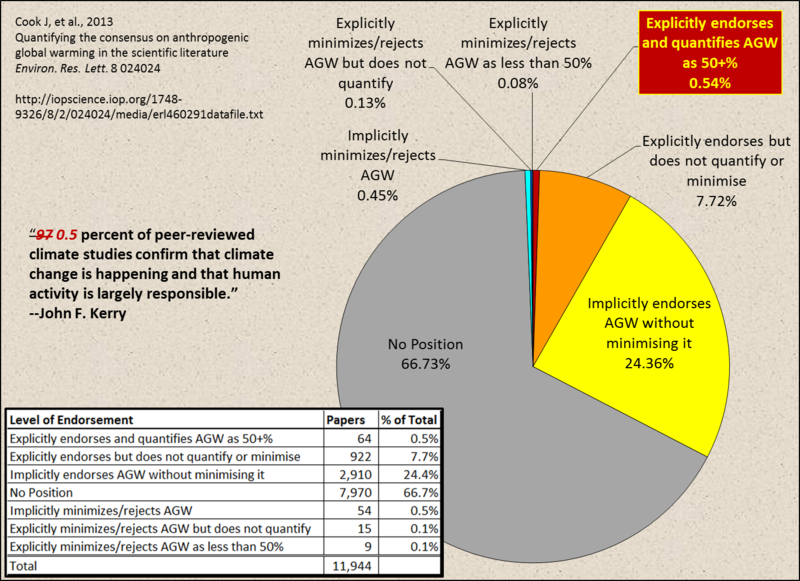
The largest endorsement group was categorized as “implicitly endorses AGW without minimizing it.” They provided this example of an implied endorsement:
…carbon sequestration in soil is important for mitigating global climate change.
That should never be enough to put an abstract into the largest sector of the 97%, the yellow piece above? It implicitly mentions climate change but not anthropomorphic, and is a pretty weak endorsement. This is supposed to be Cook J's example?
I haven't looked into that much further. Of course Mr. Purple is a player and he wants to play the game too.
…carbon sequestration in soil is important for mitigating global climate change.
That should never be enough to put an abstract into the largest sector of the 97%, the yellow piece above? It implicitly mentions climate change but not anthropomorphic, and is a pretty weak endorsement.
It implies that it is important
to mitigate global climate change.
We can argue on that point.
'course if we wind up arguing on that point, it's a pretty weak endorsement.
So it's back to what I asked long ago, what is the evidence people are the cause of global warming. Nobody came up with an answer.
From 2007 in response to a documentary called 'The Climate Swindle"
[YOUTUBE]QHODxDlRdRQ[/YOUTUBE]
The ramifications of getting this wrong make it unlike almost any other issue of the modern age.
If we act against climate change without needing to - then what are the ongoing implications of that?
If we need to act against climate change and we don't ... what are the ongoing implications of that?
Unless the scientific consensus were to swing significantly towards disbelief in climate change (or more accurately against man's role in causing it) I'd really rather we hedge our bets and do something to try and reduce our impact on climate. Tootle about trying to lessen our impact on climate when we aren't actually responsible for it in the first place risks causing a bunch of economic upset and social change - do nothing when we are the cause and we risk our own extinction.
If we act against climate change without needing to - then what are the ongoing implications of that?
At the moment - it means quickly increasing the expense of all energy, leading to more poverty, and the third-world is likely to be unable to get the "leg up" that countries with early access to carbon were able to get, leaving them permanently behind. (Poorer nations always argue to be kept out of things like Kyoto for that reason.)
Because nations disagree on how to manage the problem, and "rogue" nations are likely to take advantage of the economic imbalance, a treaty system will not be enough to guarantee success. Entire nations will be made poor or rich by following or not following the protocol. Many people will survive or starve on this basis. Governments will fail or be voted out, and will be replaced with governments that are willing to burn fuels. For example, most of Arabia would immediately become poor, and their societies would fail.
So there will have to be a global enforcement agency - let's just call it "World Police" - with authority to override local Constitutions. It will monitor emissions and, if necessary, use violence and even wage war on those nations that do not follow policy.
There will have to be a very rapid increase in fracking for natural gas, which doesn't generate as much carbon. Although many people feel fracking itself leads to too much methane emissions, because that's also a greenhouse gas. I understand that some scientists believe that methane is not a big concern when CO2 is present in large amounts because they filter similar frequencies. There is no consensus.
At this time it is felt by some scientists that all this action would not be enough to prevent a snowballing effect of geometric trends, things like loss of ice decreasing reflectivity leading to more heat leading to less ice etc, and that warming would continue anyway if we stopped today, as there is enough CO2 already present to keep the trend going for decades. But on that there is no consensus.
If we need to act against climate change and we don't ... what are the ongoing implications of that?
There is no consensus.
Some scientists believe that the warming will continue to increase, whilst others believe that the "pause" is due to reaching limits on how much increase in heat the greenhouse effects can really force upon the world, and that natural limits restrict the increase to 1-2 more degrees.
It's tempting to come up with the apocalypse, because there is a natural tendency for end-of-the-world stories to be shared.
More than tempting actually; it's built-in. It's what we do. It's the entire history of mankind! Humans present competing ideas, in which the end of the world will be the result, if we fail to adopt their beliefs and behave accordingly.
It should give everyone pause, and a sigh of relief, to consider that after a century or more of warming, mankind is more successful right now than at any time in history.
In fact, we need to continue to use the carbon fuels, to continue to quickly improve humanity, to the point where it can solve the very problems it has created for the planet.
The amount of knowledge, intelligence, and capabilities we have continue to increase on a massive scale. Today we look at the issues of the planet and we can only worry. But we are still babes in the woods and our understanding of a lot of these things is in its infancy.
If we looked at the moon in the year 1900, and said it is important for us to get there, we would not have been able to do it. By the middle of the century, our understanding of *everything* had increased; fuel, space, physics, materials, etc.
Similarly we look at the planet today and can only wring our hands. But we have no idea what we'll know in 50-100 years - and the best way to guarantee we'll have more knowledge, more capability, more scientific understanding, etc. is to continue our current path of economic growth, societal improvements, etc.
In 1900 the entire planet had only (guessing here) about 100 million people with the education of a modern 10 year old. Today there are probably a billion people at that level. In 50 years there will be five billion. So when predicting the future, don't forget that progress makes all problems trivial.
Taken from that bastion of pseudoscience and supporters of liberal policy for many years: NASA (was I too sarcastic right there?) NASA does not seem to be telling us that there is no consensus.
http://climate.nasa.gov/causes/
In its Fourth Assessment Report, the Intergovernmental Panel on Climate Change, a group of 1,300 independent scientific experts from countries all over the world under the auspices of the United Nations, concluded there's a more than 90 percent probability that human activities over the past 250 years have warmed our planet.
The industrial activities that our modern civilization depends upon have raised atmospheric carbon dioxide levels from 280 parts per million to 379 parts per million in the last 150 years. The panel also concluded there's a better than 90 percent probability that human-produced greenhouse gases such as carbon dioxide, methane and nitrous oxide have caused much of the observed increase in Earth's temperatures over the past 50 years.
They said the rate of increase in global warming due to these gases is very likely to be unprecedented within the past 10,000 years or more. The panel's full Summary for Policymakers report is online at
http://www.ipcc.ch/pdf/assessment-report/ar4/syr/ar4_syr_spm.pdf.
Reading for comprehension...
IMO, after all the postings of this thread, this sentence is where UT has been heading all along.
...
In fact, we need to continue to use the carbon fuels, to continue to quickly improve humanity,
to the point where it can solve the very problems it has created for the planet
...
But, is there any reason or consensus to believe that such a goal could ever be reached ?
Simply put, if political leaders were to follow such a path...
"What could possibly go wrong ? :smack:
.
The captain of the titanic took a wait and see attitude. He couldn't have stopped the ship from sinking, but sure as hell could have made arrangements to mitigate the loss.
It's the science fiction freaks with their love of dystopian future scenarios, trying to bring it on as quickly as they can. Next time you see a zombie patrol vehicle, check for empty bean cans and methane.
Oh yes I forgot, along with a massive increase in fracking for natural gas, there will need to be nuclear power plants built. Hundreds. Using the safest known technologies. This will tide the world over until other forms of energy generation can be developed/discovered/etc, as well as innovation continuing to drive new ways of doing things without energy and through conserving energy, etc.
led bulbs man they weren't part of the equation until just now
maybe we could make the carbon into BACON DID ANYBODY THINK OF THAT
Hmm... carbon bacon? Sure, and use the resulting piles in the new nuke plants. Genius.
IMO, after all the postings of this thread, this sentence is where UT has been heading all along.
If your thoughts differ please post your own !
Or if they do not differ.
Do I understand this correctly? Yes, global warming is real. Yes, it very well may be being caused by man. But, fuck it, it's the best we got.
Am I reading that wrong? It's cool either way, I'm just checking for understanding.
That's a pretty shitty summation so I'm gonna go with yes.
I got the impression it was more like science will save us if we keep improving the breed.
This was common in the 50s when science was giving us neat new shit to buy. Then we found out not everything they gave us was cool.
Corporations weren't going to take the heat so they teamed up with lawyers to blame scientists, and for good measure the schools the scientists attended.
Scientist ~ I invented a paint that will dry in half the time.
Science/Mechanix Magazine ~ Scientist invents instant dry paint which will allow JQ Public to change his house color instantly. Better make you house numbers bigger, so you can find it, in case the little woman changes color for her bridge party.
JQ Public ~ Hey this here paint don't work like S/M Magazine said. Must be the scientist fellas fault.
I thought someone here came up with a solution to this problem years ago ...
... I need a conservatives definition of "Global Warming" ...
"Strategic posturing for nuclear winter."
If the planet warms up enough, we can set off a few conveniently placed nukes to cool things down again (pursuant to the Weapons of Mass Salvation Doctrine). Shhhhh! Tippy Top Secret.
I got the impression it was more like science will save us if we keep improving the breed.
Yes exactly I have been repeating this notion over the telegraph all day but nobody takes notice!
The IQ of the human race has been rising. Three points per decade in the US, for the last century.
And we only just now gave it the Internet, so, unless we really fuck things up, this trend will continue for a while. Most people aren't on line yet; and so, are unaware, and yet to experience their deep and lasting outrage and anger at me for my ideas.
Yes exactly I have been repeating this notion over the telegraph all day but nobody takes notice! ...
If the notion that trading off natural resources now to advance science so it can solve our natural resources problems later was valid, all our fresh water sources that were naturally potable before pollution would be naturally potable again today. Science has already given us the technology to restore them to that state; but, even where there's a will and a way it still takes time. If scientists find a solution (other than prevention) to global warming, will there still be enough time to implement it and at what cost to other aspects of humanity? Based on past performance of that notion; also, the lack of reliable time line projections for both scientific achievement and global warming, that notion seems to require a leap of faith that many don't share.
I hope you're right; but, forgive me if I prefer to hedge my bet with an ounce of prevention because it seems to still be worth a pound of cure where natural resources are concerned.
LLAP
I prefer to hedge my bet with an ounce of prevention because it seems to still be worth a pound of cure where natural resources are concerned.
That doesn't matter because you don't have the power to act on your convictions. The ones with the power benefit more by maintaining the status quo. And if the oceans rise, or weather becomes intolerable, they'll tell the staff they're moving to one of their homes in a more pleasant location.
You see, it's not two sided, I take the third side.
It ain't my fault, it ain't my decision, ain't nothing I can do about it, it's all THEIR fault. :haha:
Your third side is a copout typical of people who don't have enough time left to get involved which also means that when it comes to whether or not I can act on my convictions, you don't have a mouth.
Of course it is, it's apparently also the majority opinion in this country.
We are Legion.
We do not know.
We do not care.
Expect beer.
You're right, I apologize, I should have said effectively act on your convictions. :p:
It's cute when old folks like you and UT try to use reverse psychology on others so they'll make your cases in rebuttals.
The majority opinion in this country changes every 4 or 8 years. I'll be around to affect the balancing act for awhile yet. While I'm not a proponent of your third side, I see a middle ground.
Yes exactly I have been repeating this notion over the telegraph all day but nobody takes notice!
The IQ of the human race has been rising. Three points per decade in the US, for the last century.
And we only just now gave it the Internet, so, unless we really fuck things up, this trend will continue for a while. Most people aren't on line yet; and so, are unaware, and yet to experience their deep and lasting outrage and anger at me for my ideas.
The fly in (y)our ointment would seem to be governing ourselves in the mean-time. We seem to be electing a lot of controlling mother-fuckers who'd like to impose their pre-human values on others. Our fascination with war to teach democratic values to the unenlightened seems counter-productive unless we can bomb them with high speed internet, something we still haven't bombed rural America with.
It's cute when old folks like you and UT try to use reverse psychology on others so they'll make your cases in rebuttals..
Wrong analysis. I'm tired of going round and round, like a dog chasing his tail, on this. Everyone has staked out their position and will not be swayed, because they're not even listening anymore.
The majority opinion in this country changes every 4 or 8 years. I'll be around to affect the balancing act for awhile yet. While I'm not a proponent of your third side, I see a middle ground.
The majority opinion on
what changes every four to eight years? Certainly not on global warming/climate change/what to do about it.
Besides, even if the majority opinion flops one way or the other, so what? Congress doesn't care, they do what they're told by the people who own them. They'll do it without fear of voter backlash, too, because the few that vote are so stupid they'll vote against their own, and the country's, best interest when the party says to.
I took my leading questions and [strike]crossed them out![/strike]
Then they were needed anyway.
If the notion that trading off natural resources now to advance science so it can solve our natural resources problems later was valid, all our fresh water sources that were naturally potable before pollution would be naturally potable again today.
They are, or is this one of those leading questions? Once we figured out we were doing this type of damage, we moved an awful lot of the water polluting to other countries. We made it illegal in the rich places, thus promoting manufacturing in poorer countries without such regulations.
It all worked, and now rivers and lakes that were heavily polluted are now clean. The Cuyahoga River is no longer on fire. Boston Harbor hosts wildlife now. You could swim in major metropolitan rivers now.
The Clean Water Act is considered one of the most successful pieces of legislation ever. And now, previously clean rivers and lakes in China are now choked with algae and pollution, worse than the west's ever were. We successfully moved the problem out of our backyard.
That's why I said we are going to need World Police to pressure AGW by force. As energy gets more expensive, the worst people on the world will get money and power by using it any way they see fit. Problem is global so moving it isn't going to work.
Unless we move it to outer space...
Once we figured out we were doing this type of damage, we moved an awful lot of the water polluting to other countries. We made it illegal in the rich places, thus promoting manufacturing in poorer countries without such regulations.
Delaware River above Port Jervis (northern tip of New Jersey) was some of the cleanest water. Rated Grade A by the National Park Service. In Reagan's day, one could see it getting dirtier. And yet it was still Grade A because it was so clean. During Clinton's time we saw it get cleaner.
So why does Philadelphia not take their water from the Delaware River? Because it is so dirty. Cleaner water is obtained from the Schukylll River. So what happens in 100 miles from the cleanest of the clean to so dirty? Clearly this does not happen if we have so successfully cleaned up the rivers.
Meanwhile Americans pay $35 for gasoline. Only $4 moves the car. $31 is wasted as heat and noise. If we addressed real reasons for global warning (a major shortage of innovation), then $12 of $35 moves a car. But we do not do that. Since 1970, what has been the purpose of every American auto company? Not to make a better product. To make more profits. To enrich top management.
Why do companies with misguided objectives so harm the environment? Many if not most innovation that makes better cars and reduces harmful impacts to the environment eventually appear as patriotic American cars made by better American patriots who are citizens of Korea, Japan, and Europe. After all, less destruction to the environment also means higher gasoline mileage. Why is that not important and good?
The if not a most significant reason for Global Warming are so many Americans who hate innovation. As apparent even by fools so who hated environmental controls in 1970s automobiles. Large numbers of Americans so hate America when they advocate hate of innovation and the resulting progress. These fools love the status quo. Denial of global warning and reasons why it exists are typically found in those who hate innovation and the advancement of mankind.
...The Clean Water Act is considered one of the most successful pieces of legislation ever. ...
CLA is second only to:
National DO NOT CALL RegistryIf the notion that trading off natural resources now to advance science so it can solve our natural resources problems later was valid, all our fresh water sources that were naturally potable before pollution would be naturally potable again today.
Here, "our" refers to the
world's natural resources, not just this country's. Global warming to global water pollution, apples to apples. There's just a longer time line for water pollution anywhere to become a problem for everyone everywhere compared to air pollution. My contention was that even if science comes up with a technological solution to global warming (as it has for water pollution), it will take time to implement globally and associated costs will take a toll on other aspects of humanity. UT reinforced those points. Thank you.
I don't fall into either the
science will save us or the
there's nothing we can do categories. The former is just another rationalization for holding the latter position. Did you ever notice that people who think we'll need a World Police for something are often the same people who think we shouldn't be the world's police (even though we may be the lesser of all evils). Fascinating.
LLAP
Did you ever notice that people who think we'll need a World Police for something are often the same people who think we shouldn't be the world's police (even though we may be the lesser of all evils). Fascinating.
It would be [strike]easy[/strike] less difficult to get every country to comply if they could be squeezed financially, but free enterprise and black markets rule that option out.
So how the fuck can you enforce rules on countries that don't want them? Who makes the rules? Vote on them? One vote per country whether they have a Billion or 238 citizens? Putin? Kim?
Say we are the world police, and a country says fuck off, you're not the boss of me. Would you support a war to enforce environmental rules? A war with a nuclear power?
How about Russia being world police? Would you say, yes boss, right away boss? No? What makes you think they would?
So many questions, so misdirected. We'll conquer the world through the time honored tradition of intermarriage. Of course, we may have to make sacrifices such as having more than one spouse to make it work in time to prevent global warming. How many can I put you down for?
[COLOR="SlateGray"](contingent upon Mexico not conquering us first)[/COLOR]
No thank you , been there done that, been their done that.
Times UK: "We were wrong — worst effects of climate change can be avoided, say experts"
OK that is paywalled so let's turn to the Independent:
"Global warming may be occurring more slowly than previously thought, study suggests"
At the Paris climate summit in 2015, Professor Grubb said: “All the evidence from the past 15 years leads me to conclude that actually delivering 1.5C is simply incompatible with democracy.”
But speaking to The Times he said: “When the facts change, I change my mind, as [John Maynard] Keynes said."
I picked this thread for these links because this thread is where I disrespected the IPCC, before the Paris conference... the same IPCC that Grubb now disrespects.
~ I believe that "warmism" is turning into the correct position: mankind has added to the heat, but not as much as they say, and it's not as devastating as people think ~
Warning, I'm not that smart. I only have been following the science semi-casually, and making educated guesses.
But I do know, there is NO scientific consensus on the end of the world. And it's extremely hard to predict the future. Please consider that as you read the media.
It does not say that it's not a problem, just it's not happening as quickly as earlier predicted. Not if, but when. He also says that gives us more time to do something about it, but do something we must.
As far as flooding the low lying islands and shores, The
91 volcanoes under the southern ice cap may be a bigger problem.