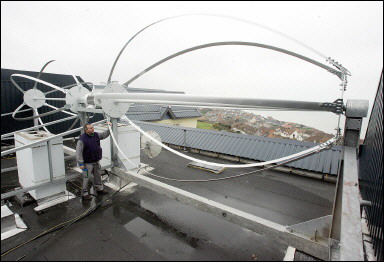
This eggbeater design is known as a Darrieus wind turbine .. named after its French inventor, who thought it up around 1927 ..
The interesting part about this design .. and linknoid has just touched on it .. is that the blades are built around an airfoil principle, and cannot self start - but must be cranked to get going.
Once running, they are more efficient than the regular propeller design, due to the airfoil design providing "lift" just like an airplanes wing.
Likewise, they have a lower velocity of the outer part of the blades, at speed .. unlike propellor designs, whereby the high speed of the prop tips starts to create drag at high rotational speeds .. as well as increased noise.
The Darrieus designs do have a problem with sinusoidal (pulsing) of the blades .. meaning at certain RPM's, they develop a "whip", which can break the blades if left at the critical RPM for too long.
This is a similar problem to the longitudinal whip which can develop in an internal combustion engine crankshaft, which can also break the crankshaft. Torsional dampers on IC engines help prevent crankshaft whip .. but they do not appear to be feasible with Darrieus turbine blades, because torque on the turbine blades is not a factor in the problem, unlike crankshafts.
The interesting part of the particular Darrieus wind turbine, pictured, is that they have crossed the design with a propellor design, by lying it down, and effectively turning it into a "horizontal axis" machine .. whereas most Darrieus arrangements are "vertical axis" generators.
By doing so, they have eliminated a major amount of cost, by not having to have, a massive base structure, bearing and guy wires.
The normal Darrieus vertical axis generators, although not needing a heavily-built tower for support .. are stuck with the problem of needing guy wires for support .. and the problem of needing to be nearly totally dismantled for any bearing or generator repairs.
To add complexity to interest .. high buildings generate substantial vertical wind currents .. and this particular turbine design above, appears to be following a Dutch design, known as the "Turby" design, which has blades with a helical cant, to take advantage of vertical air currents, as well as horizontal ones ..
More on wind turbine designs ..
http://en.wikipedia.org/wiki/Darrieus_wind_turbine
I trust the "Turby" turbine design, performs far better than their website ..
http://www.turby.nl/
Windwall is the Dutch company that installed the French unit pictured, and their website is quite informative ..
http://www.windwall.nl/eng/aboutwind02_eng.htm