10/27/2005: German water bridge

Undertoad • Oct 27, 2005 9:03 am
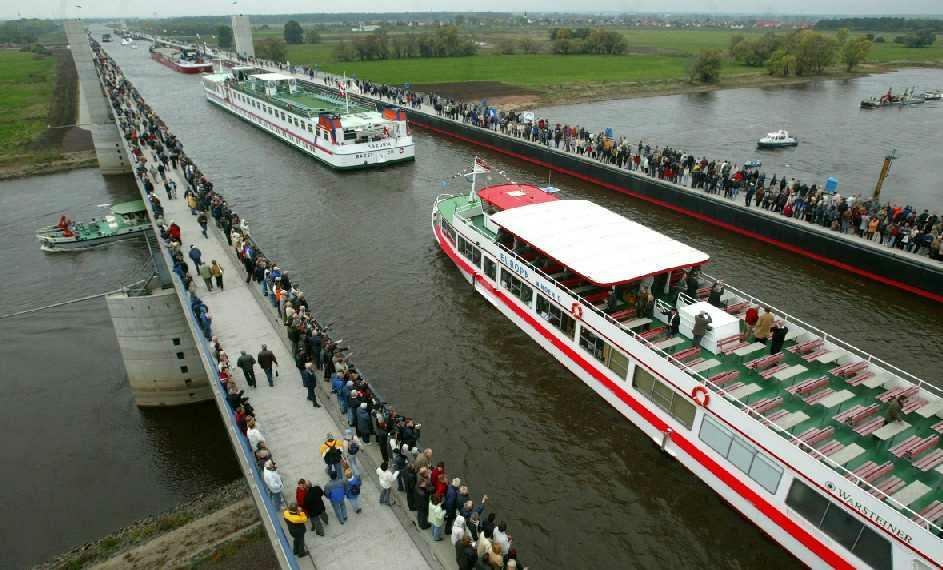
Image

It's not a new installation, but I'd never seen it before someone sent along this Snopes entry which confirms. This is an actual water bridge, an amazing feat of engineering. A kilometer in size!

At the center of the project is Europe's longest water bridge measuring in just shy of a kilometer at 918 meters. The huge tub to transport ships over the Elbe took 24,000 metric tons of steel and 68,000 cubic meters of concrete to build.

The water bridge will enable river barges to avoid a lengthy and sometimes unreliable passage along the Elbe. Shipping can often come to a halt on the stretch if the river's water mark falls to unacceptably low levels.
Trilby • Oct 27, 2005 9:10 am
That is really cool. Those German engineers are hawt.
glatt • Oct 27, 2005 9:27 am
I like that. Very impressive.

Here's an old school one on the Erie Canal in Rochester.

Erie Canal water bridge
xoxoxoBruce • Oct 27, 2005 11:00 am
Well duh, the Romans did it thousands of years ago. :lol:
Sundae • Oct 27, 2005 11:13 am
I am being charitable and assuming that the picture was taken on the opening day, or some other gala event.

Otherwise I'd have to conclude that there wasn't an awful lot of excitement in those parts......
sktzofrenic • Oct 27, 2005 11:45 am
I can't help but think that there are cheaper and more practical ways to move people and goods then a gigantic water bridge...

forgive my cynicism... :cool:
Happy Monkey • Oct 27, 2005 12:24 pm
I doubt it, in the long run. Barge-loader-truck-loader-barge is more complicated than barge. The cost of the bridge can be divided into all of the transfers that are saved during the lifetime of the bridge. And if the bridge was constructed well, that lifetime should be very long.
John • Oct 27, 2005 12:24 pm
I can't help but think that there are cheaper and more practical ways to move people and goods then a gigantic water bridge...

Not really. Water transport is among the most efficient methods available - and, when the Elbe is impassable, transport comes to a dead halt. "working around" would involve doubling the number of ships (one above the impassable section, one below), unloading the cargo, transporting the cargo by land, and re-loading it onto the new ship.

Multiply that by EVERY SHIP. Consider that you don't have any way to predict when this is necessary and when it isn't.

No, the bridge is probably the most efficient way of doing things, overall, just like canals and tunnels are often more efficient than going around, even if they're harder to build.
mrnoodle • Oct 27, 2005 1:50 pm
Keep in mind, the Germans built it. They're not known for extravagance if there's not a utilitarian payoff.
xoxoxoBruce • Oct 27, 2005 9:33 pm
Actually there's a little more to it. Included in this project is a couple of locks. This project, in the works since the 30s, ties the east German and West German canal systems together.
It allows them to move freight cheaper but it also enables them to move [SIZE=5]BIG[/SIZE] stuff that can't be moved through the back roads and small villages. ;)
zippyt • Oct 27, 2005 9:43 pm
this is VERRRRRY COOL !!!!
Just imagen how much weight is on those pileings !!!!!
( ok math geeks , this is your moment to shine !!!)

Oh and I wounder if said weight goes up as a barge passes over said pileing ??? or if it is evenly distributed and displaced by the boyency of said barge ???
Tanalia • Oct 27, 2005 10:26 pm
zippyt wrote:
this is VERRRRRY COOL !!!!
Just imagen how much weight is on those pileings !!!!!
( ok math geeks , this is your moment to shine !!!)


Not enough data from the story, but it shouldn't be much more than maybe 5 or so times that for a comparable highway bridge (it's effectively just a thick layer of water on top of a highway...), which looks about right from the size of the supports.

Oh and I wounder if said weight goes up as a barge passes over said pileing ??? or if it is evenly distributed and displaced by the boyency of said barge ???


Not really. If you could just drop a barge in the middle, there would be a local spike in the weight until the displacement was spread out (which would be very rapid) -- the water level over the whole bridge would rise a tiny bit and each support would share the load.

Since the barges are introduced via locks, the water level in the lock is matched to that of the bridge, and each barge displaces its weight in water, so there is no net increase in weight. This would be the same as if you could drop it in and then remove water until it was back at the original level, returning it to the original weight.

As long as the water level is maintained and there are only floating objects, the weight remains the same.
tw • Oct 27, 2005 10:46 pm
Above is new version of an old technology. Roebling demonstrated suspension bridges in 1848-1851 by building four suspension bridges to carry 30+ foot coal carrying barges from Carbondale PA destined for NYC on the Delaware and Hudson Canal. This technology was later used in 1883 to create the Brooklyn Bridge.

Some pictures of Roeblings oldest and still existing bridge. Second is before side walls were restored. This bridge carried something like seven feet of water, 20 feet wide, for about 130+ feet across the Delaware at a junction to the Lackawaxen River (what now empties Lake Wallenpaupak).
Image

Yes those are people under that bridge that was built by hand:
Image
Sun_Sparkz • Oct 27, 2005 11:11 pm
you could catch a flathead on your way to work anyway......
Lizsun • Oct 27, 2005 11:21 pm
Simon and Garfunkle,"Like a Bridge of untroubled water over troubled water, I won't lay me down . . . or I'd drown"

Liz
http://lettingmebe.blogspot.com
xoxoxoBruce • Oct 28, 2005 2:31 am
(it's effectively just a thick layer of water on top of a highway...),
4.25 meters thick and 30 meters wide, layer of water. :mg:
capnhowdy • Oct 28, 2005 9:27 am
I need to know how they keep the water level regulated. I'm sure they pump the water into it some way. What is at either end? Seems to me that gravity is not your friend on a project like this. But then again... I'm no engineer.
Sundae • Oct 28, 2005 10:05 am
capnhowdy wrote:
I need to know how they keep the water level regulated.

Have you decided to build one?
busterb • Oct 28, 2005 10:25 am
The Falkirk Wheel. http://www.thefalkirkwheel.co.uk/index.asp?cat=HISTORY%20::%20DESIGN&aux=1 FYI
capnhowdy • Oct 28, 2005 10:26 am
a question is not an answer

an answer is not a question

but for the record... no, not today. ;)
capnhowdy • Oct 28, 2005 10:28 am
Thanks for the link busterb. Very interesting.
xoxoxoBruce • Oct 28, 2005 11:49 am
Yeah, good one Buster. :thumb:

capnhowdy, I believe one end is the same level as the canal system and the other end has 2 locks to drop to the level of the other canal system.
RobPett • Nov 2, 2005 2:02 pm
For those of you with Google Earth installed, here are what I THINK are the coordinates: <52.2310791033, 11.7016471392>. Looks like it's still under construction in this satellite photo...
glatt • Nov 2, 2005 3:00 pm
RobPett wrote:
For those of you with Google Earth installed, here are what I THINK are the coordinates: <52.2310791033, 11.7016471392>. Looks like it's still under construction in this satellite photo...


Cool. Thanks. That's the start of a long canal system. I had no idea how many canals there were in East Germany.
noviceathome • Nov 3, 2005 9:42 am
zippyt. no. yes exactly. where the barge is the equivalent weight of water isn't.