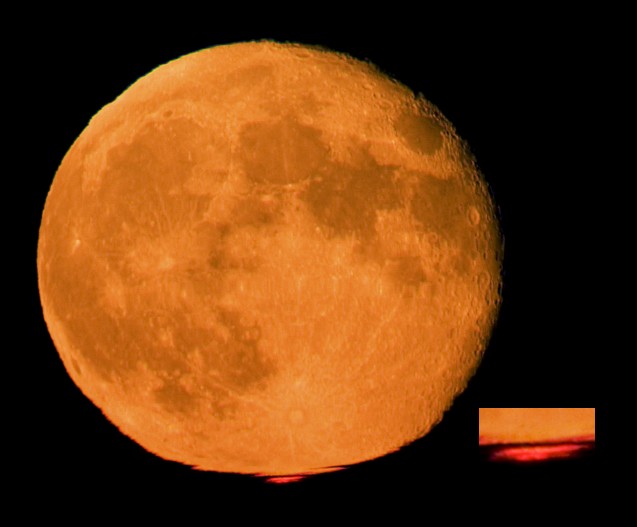
Tell me where all this red 'scattered' light is at midnight? The moon is red because that is the red light refracted through the earth's atmosphere - the only source of light to illuminate the moon. Blue light does not bend sufficiently AND therefore does not illuminate the moon. The amount of red light that illuminates the moon is the amount of red light refracted through the earth's atmosphere.
At midnight, tw, all the light, red, blue, and otherwise, is on the opposite side of the planet. Shining on the planet. Shining on the atmosphere. Shining through the atmosphere. For those folks actually on the opposite side of the planet, where it would be midday, absent cloud cover, they would see this light, and the sky would be blue. It looks blue because the blue light of the visible spectrum of light scatters the most, "filling the sky" with that lovely blue color. You're seeing the atmosphere.
Those folks about six hours away in either direction see a rosy sunrise or a rosy sunset, weather conditions permitting. You yourself, and every other non blind or color blind person reading this post has had considerable first hand empirical evidence of this. Pay attention. Because the people near the terminator, the line between light and dark, have to see the sun or moon through so much more atmosphere, so much more blue light is scattered, and the proportion of light that does still get through without having been scattered is much higher in the redder frequencies. Roughly speaking, sunlight minus blue equals red.
Now, let's continue on to midnight. As an observer on the surface of the earth, the sunlight you're able to see at midnight would have to be reflected off of something. This is because the sunlight IS refracted. ALL sunlight. The variation, of how much more or less a given frequency of light is refracted is called dispersion. It only amounts to about 1% across the visible spectrum, and for our purposes, is irrelevant.
From here:
Refraction is slightly different for different colors of light. This variation of the refractive index with the wavelength or frequency of the light is called dispersion. Dispersion is a property of all transparent materials.
The color of green flashes is due to the dispersion of air, which makes atmospheric refraction slightly different for different parts of the spectrum. The dispersion of air, like that of water, glass, clear plastics, and most other materials, is small: the refractivity (n - 1) varies by about 1% across the visible spectrum.
Because dispersion is so small, it is negligible for many purposes. Only in special situations is the dispersion of air visible to the naked eye.
So ALL light is refracted (including the blue frequencies) through the earth's atmosphere. A quick review of what
refraction is:
Refraction in geometric optics is the change in direction of a wave due to a change in velocity. It happens when waves travel from a medium with a given refractive index to a medium with another. At the boundary between the media the wave changes direction; its wavelength increases or decreases but frequency remains constant. For example, a light ray will refract as it enters and leaves glass; understanding of this concept led to the invention of the refracting telescope.
Emphasis mine. Refraction happens at the boundary between space and atmosphere and again at the atmosphere space boundary on it's way back out of the atmosphere. Incidentally, it is refracted again as it reflects off the moon and into your eye, refracted again at the air/cornea boundary. Finally it is absorbed by the rods and cones on your retina. But I digress.
As the sunlight passes through and is refracted at the space/air boundary, it only CHANGES DIRECTION, NOT FREQUENCY. What goes in red comes out red, what goes in blue comes out blue. But there's the rub. The blue doesn't come out in our lunar eclipse model, it's
scattered much much more by the
]dramatically longer slog through our atmosphere than the red is on its way from the sun, through the
limb (second definition) of the earth, to the moon and back.
That, tw, is why the moon appears red during an eclipse. The blue frequencies are scattered more than the red frequencies. You only see what gets to your eyes. Or maybe you don't. But not through any fault of mine.
My odometer is only good to a mile. So how do I measure the distance between two points to within a hundreth of a mile? It's called statistics. Take enough data to obtain an accurate reading. Other variables to this experiment are included when taking that data; only some I have listed. But these variables are taken into account when measurements over generations showed a decrease in the amount of light reaching the moon - through earth's atmosphere.
Your assumptions about clouds and crude measuring assume no knowledge of statistics and no use of instruments. These experiements (and others including a measurment of sun's intensity) have been ongoing for decades using calibrated instruments; meaning these 'course measurements' by science have resulted in accurate data.
Meanwhile the course measurements that Big V cited from Danjon Scale of Lunar Eclipse Brightness are how the laymen - without instruments - can ball park the same experiment. That citation also says BigV's own citation confirms that lunar eclipses measure the clarity of earth's atmosphere.
Yeah, like
this instrument measures weather.
--covered earlier--
I thank you for confirming what I had posted. The illumination of the moon by light refracted in earth's atmosphere is one method to measure clarity or contamination of earth's atmosphere. Big V confirms how the experiment is performed- and how laymen without instruments can do the same experiment.
Hey, my pleasure. Anything I can do to bolster your credibility is a blow to the evil MBAs of the world, and to our mutual benfit.