xoxoxoBruce • Nov 13, 2019 11:50 pm
In 1054, Chinese astronomers observed a star that glowed particularly bright for two years and then winked out. We know now that they were looking at a supernova, the terminal explosion of a star, when its core collapses under its own gravity. The remains of that cosmic explosion, the Crab Nebula, some 6,500 light years away from Earth, are no longer visible to the naked eye. The nebula was first identified in 1731 by the doctor and astronomer John Bevis, and we’ve been watching it ever since—but it’s never looked quite like this.
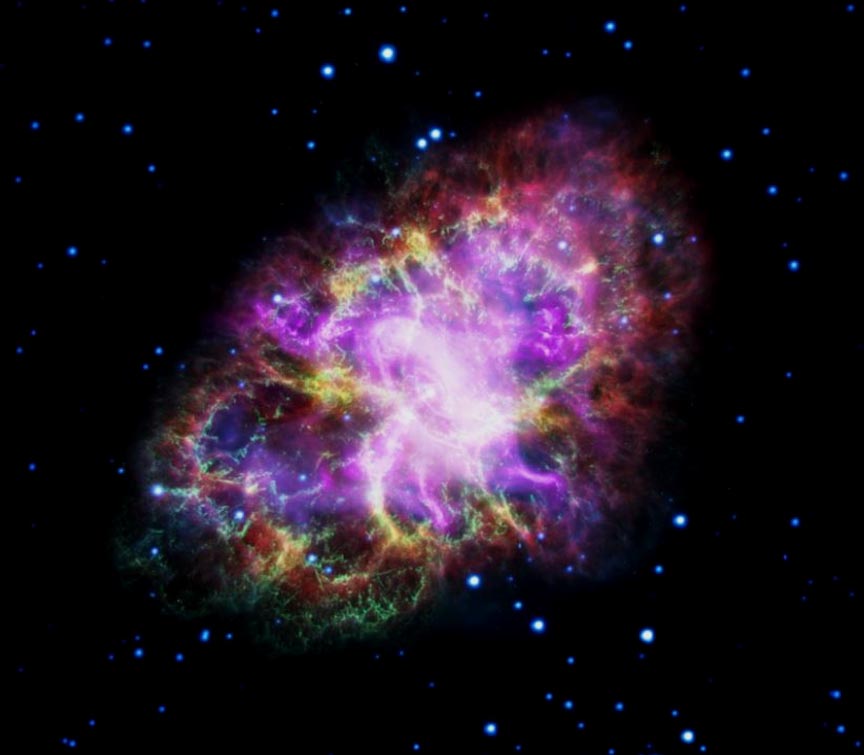
By assembling the data from five telescopes:
Very Large Array (radio),
Spitzer Space Telescope (infrared),
Hubble Space Telescope (visible),
XMM-Newton Observatory (ultraviolet),
Chandra X-ray Observatory (X-ray),
tint the data from each a different color and overlay them for unprecedented detail.
The bright spot at the center is a pulsar, a tiny neutron star that rotates rapidly (30 times per second), sending out electromagnetic beams like a lighthouse on overdrive. It is surrounded by a swirl of particles caught up in the pulsar’s magnetic wind, followed by the remnants of the supernova, and then finally material ejected from the star before it exploded. The comparative data are helping scientists understand the structure and physics of the nebula, which is three light years across.
I don’t know if there’s a purpose to all this investigating other than simply the possibility of learning something they didn’t know.
I figure cataclysmic shit of this magnitude will happen, and we can’t do anything but watch.
When you are in the valley and a huge avalanche comes hurtling down the mountain at you does it help you in any way to know
the coefficient of friction between the flakes?
link