Mar 14th, 2017: Deep Learning

xoxoxoBruce • Mar 13, 2017 11:52 pm
Anything you can do they can do better,
They can do anything better than you.
Not you, humans. They are computers used to design things, especially 3-D printed things.
Image

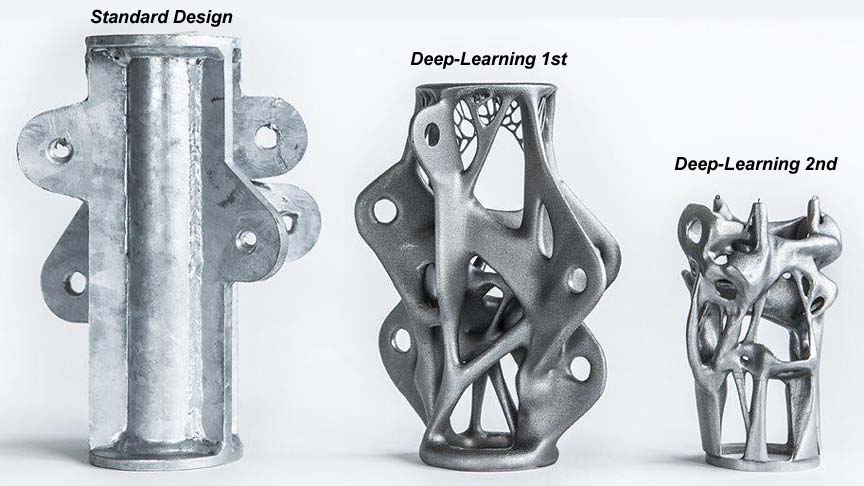
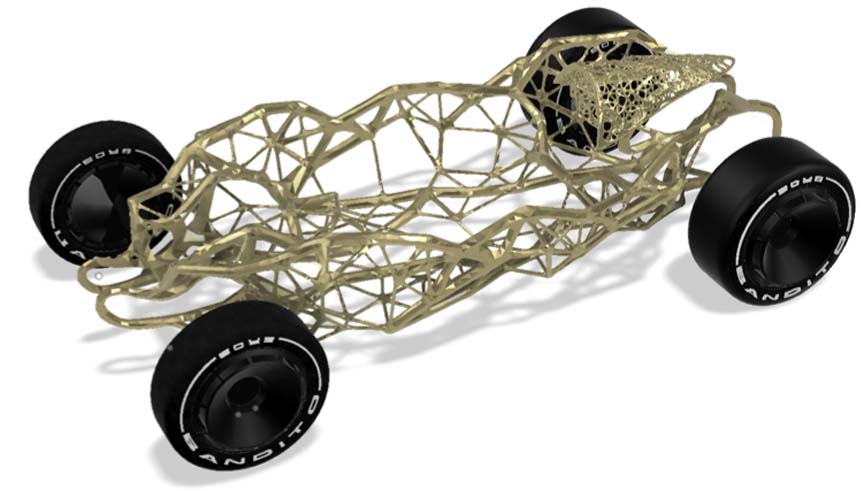
What happens when you have Deep Learning begin to generate your designs? The commons misconception would be that a machine’s design would look ‘mechanical’ or ‘logical’. However, what we seem to be finding is that they look very organic, in fact they look organic or like an alien biology. Take a look at some of these fascinating designs.


Image

“This is not only an exciting development for the construction sector, but many other industries as well. In the case of this particular piece, the height is approximately half that of one designed for traditional production methods, while the direct weight reduction per node is 75%. On a construction project that means we could be looking at an overall weight reduction of the total structure of more than 40%. But the really exciting part is that this technique can potentially be applied to any industry that uses complex, high quality, metal products.”


Image

The computer calculates the stresses, knows the material's strength and calculates what is needed.
Fine, but what is the calculation using for data? Tables somebody gave it? Are the accurate?
If you tell it to design for maximum weight savings you get a design the is just strong enough for the parameters it's given.
If you tell it to program for low cost it depends on the data for a safe design.
I can see a lot of slaves in this woodpile. :eyebrow:

link
Beest • Mar 14, 2017 8:46 am
The stress optimized designs are certainly weird looking. I've not seen any in practical use, that bicycle part looks like it would be an 'interesting' test.

Of course in an engineering design required strength is calculated, then a safety factor applied, cost and weight are minimized to provide this level of strength.
Light weighting is a big deal in automotive design currently, reducing weight to help meet fuel efficiency standards.
xoxoxoBruce • Mar 14, 2017 8:59 am
Beest;984235 wrote:

Of course in an engineering design required strength is calculated, then a safety factor applied, cost and weight are minimized to provide this level of strength.

Yes, when engineers do it, but what happens when the design engineers are replaced with contract hungry programmers, who win or fold?

Light weighting is a big deal in automotive design currently, reducing weight to help meet fuel efficiency standards.
When I look at that frame design the thing that comes to mind is how the fuck do you repair that?
Undertoad • Mar 14, 2017 9:01 am
You 3D print an exact duplicate part. Takes 5 minutes!
Snakeadelic • Mar 14, 2017 9:03 am
I find it intriguing how differently learning is handled by different "students". A group of scientists taught a group of captive-raised monkeys the concept of money by getting them to associate desired behavior with the reward of a small metal circle, which they could then put in a specifically designed vending machine for whatever food treat (visible through windows) they were in the mood for.

Not long after, they noticed something. Male monkeys were performing--and even over-performing--the desired behaviors. Upon getting their "coin", they'd either get a food treat or just hand the "coin" over to a female, who would then reward the male with sex. Yup, we taught monkeys about money and the FIRST thing they invented was sex for hire.

Now we teach a computer about stresses and physics and calculus and all that goes into this kind of research, and the stress-optimized designs it comes up with all look vaguely biological. That last photo, the piece that looks like it should clip together, reminds me a LOT of the structure of bird bones, which have just about the best stress-for-weight ratio found above the benthic zones of the oceans.

If the current political administration hadn't just gutted every bit of scientific funding (even NOAA lost a massive chunk of its budget...good luck directing your military without weather satellites!) I'd be a lot more excited about the immediate future of this kind of research.
xoxoxoBruce • Mar 14, 2017 9:06 am
I think that automobile frame would take a lot more than 5 minutes, even if repair shops had the capability. Of course it's a copy righted part so it would take awhile to do the paperwork and pay the royalties.
glatt • Mar 14, 2017 9:11 am
I wonder if they used that technology to design the Klymint ultra-lightweight backpacking sleep pad? Packs up smaller than a soda can.
[ATTACH]59754[/ATTACH]
Griff • Mar 14, 2017 12:19 pm
[youtube]6QBRjp9-uJg[/youtube]

Mind your contractor...
Griff • Mar 14, 2017 12:23 pm
glatt;984243 wrote:
I wonder if they used that technology to design the Klymint ultra-lightweight backpacking sleep pad? Packs up smaller than a soda can.
[ATTACH]59754[/ATTACH]


like to try that...
glatt • Mar 14, 2017 12:36 pm
glatt;984243 wrote:
I wonder if they used that technology to design the Klymint ultra-lightweight backpacking sleep pad? Packs up smaller than a soda can.
[ATTACH]59754[/ATTACH]

I found this graphic which seems to match my own experience.

Do the pressure points line up?
[ATTACH]59756[/ATTACH]

Looks to me like the shoulder area is under padded, assuming the head area is closest to us.
xoxoxoBruce • Mar 14, 2017 1:17 pm
Griff;984269 wrote:
Mind your contractor...

That is exactly my worry, the machine designs and builds according to the ethics/goals set by whomever controls the input.
SPUCK • Mar 21, 2017 3:35 am
Fear not Bruce. The resulting designs are thrashed to show weaknesses and failure so it can be fed back into the program and around and around refining the result.

If it is going into a consumer good like a car there is no way a sub-par result would be let out. They'd also take the result and run it thru their standard stress analysis programs.
xoxoxoBruce • Mar 21, 2017 5:27 am
If I have an accident they straighten and weld my frame, how do they repair that spaghetti in picture 2? It's something that's going to be buried in a unibody type construction so I doubt it can even be accessed.

My fear is this leads to more disposable goods that can't be repaired. Sure, make it out of more recyclable material for the good of the environment. But disposable shit isn't good for the consumer's wallet.

The tea kettle dies and is unrepairable, buy a new one. The TV dies and costs more than a new one to fix, buy a new one. The couch costs more to reupholster than a new one. Buy a new one. It keeps creeping up the scale.
Flint • Mar 23, 2017 1:12 pm
Somebody said, just 3D print a replacement part... Can 3D printers print parts in high-carbon steel??
footfootfoot • Mar 23, 2017 3:20 pm
Flint;984927 wrote:
Somebody said, just 3D print a replacement part... Can 3D printers print parts in high-carbon steel??


I'm sure they can, you'd just need something like a wire feed welder instead of an inkjet and viola! Or voila, if you're french.

I think Bruce posted a video of a guy who built a 3-d cement jet printer and went of to print a castle.

And Bruce, the reason for the spaghetti shaped frame is that you'd never really know if they repaired it or not. They could do anything, really, and most of us would say, "Looks legit."

@ Snake, I have a shit ton of washers, does that mean I can get busy with a special group captive lady monkey? I mean for science's sake.
Gravdigr • Mar 23, 2017 3:56 pm
footfootfoot;984930 wrote:
And Bruce, the reason for the spaghetti shaped frame is that you'd never really know if they repaired it or not. They could do anything, really, and most of us would say, "Looks legit."


They programmed future deception into the computer?:eyebrow:
xoxoxoBruce • Mar 23, 2017 6:29 pm
I read they are printing with aluminum. The aluminum is melted in a furnace then flows into a nozzle where it's superheated by induction until there is enough pressure to blow out one drop. I'd be concerned how homogeneous the finished piece is. Have to assume someone is looking at that, because I didn't pay all those taxes to school those little fuckers for nothing.

They hope to be printing with steel soon, but I'll bet it's not high carbon or high strength steel.
SPUCK • Mar 24, 2017 4:40 am
They print titanium and don't forget as a publicity stunt they printed a complete 1911 45 out of steel and then demonstrated the result by putting ten thousand rounds thru it.
xoxoxoBruce • Mar 24, 2017 11:37 am
Damn, I haven't kept up with this shit.
[YOUTUBE]zJyf1IrHtcE[/YOUTUBE]
footfootfoot • Mar 24, 2017 4:17 pm
Gravdigr;984935 wrote:
They programmed future deception into the computer?:eyebrow:


What kind of conspiracy theorist are you? Give back your tinfoil hat until you adjust your attitude, young man.

;)
Flint • Mar 24, 2017 4:28 pm
xoxoxoBruce;984949 wrote:

They hope to be printing with steel soon, but I'll bet it's not high carbon or high strength steel.
I'll stick with Viking crucible steel, carbon-boosted with the bones of my ancestors.

Viking Sword, "Ulfberht" or +VLFBERHT+

[YOUTUBE]J6woycxQzA0[/YOUTUBE]
footfootfoot • Mar 25, 2017 9:01 am
glatt;984243 wrote:
I wonder if they used that technology to design the Klymint ultra-lightweight backpacking sleep pad? Packs up smaller than a soda can.
[ATTACH]59754[/ATTACH]


I have to say, this is one of the stupidest fucking things I have ever seen. Designed by someone who is divorced from the reality of camping, it's not only not right, it's not even wrong.

Who remains motionless during their sleep? When backpacking, how often do you find yourself sleeping on flat ground without sticks, roots, stones, peas, and god knows what poking up from the ground? Even a small root would easily protrude beyond the thickness of the mat though one of the openings.

Seriously, people need to get the fuck off their devices, stop playing with solidworks, sketchup, and autocad and go outside and actually touch the physical world.
xoxoxoBruce • Mar 25, 2017 10:47 am
But it works fine on top of my mattress. :haha:
footfootfoot • Mar 25, 2017 3:16 pm
xoxoxoBruce;985069 wrote:
But it works fine on top of my mattress. :haha:


And would it fit in a "child sized" soda cup? @ 48 sec
:D;)
[YOUTUBE]Ish8NBunrQU[/YOUTUBE]
xoxoxoBruce • Apr 16, 2017 2:07 am
Deep Learning is raising it's ugly head in a new way.
Last year, a strange self-driving car was released onto the quiet roads of Monmouth County, New Jersey. The experimental vehicle, developed by researchers at the chip maker Nvidia, didn’t look different from other autonomous cars, but it was unlike anything demonstrated by Google, Tesla, or General Motors, and it showed the rising power of artificial intelligence. The car didn’t follow a single instruction provided by an engineer or programmer. Instead, it relied entirely on an algorithm that had taught itself to drive by watching a human do it.

Heh heh, I'd teach that sucker something. :eyebrow:

Getting a car to drive this way was an impressive feat. But it’s also a bit unsettling, since it isn’t completely clear how the car makes its decisions. Information from the vehicle’s sensors goes straight into a huge network of artificial neurons that process the data and then deliver the commands required to operate the steering wheel, the brakes, and other systems.... The system is so complicated that even the engineers who designed it may struggle to isolate the reason for any single action. And you can’t ask it: there is no obvious way to design such a system so that it could always explain why it did what it did.

"Isn't completely clear" is tech speak for Idunno.

The mysterious mind of this vehicle points to a looming issue with artificial intelligence. The car’s underlying AI technology, known as deep learning, has proved very powerful at solving problems in recent years, and it has been widely deployed for tasks like image captioning, voice recognition, and language translation. There is now hope that the same techniques will be able to diagnose deadly diseases, make million-dollar trading decisions, and do countless other things to transform whole industries.

But this won’t happen—or shouldn’t happen—unless we find ways of making techniques like deep learning more understandable to their creators and accountable to their users.


Imagine one of those Boston Dynamics robots with this. They're taking the next big leap toward our Robot Overlords. :whofart: :facepalm:

link
Clodfobble • Apr 17, 2017 7:57 am
So now imagine we've got one of those Boston Dynamics wolf-things patrolling the streets, keeping the criminals at bay... except they learned how to do their job from watching real cops.

And the robots end up racist.
Gravdigr • Apr 17, 2017 3:45 pm
xoxoxoBruce;985069 wrote:
But it works fine on top of my mattress. :haha:


And in the pool.
BigV • Apr 17, 2017 9:02 pm
Gravdigr;987010 wrote:
And in the pool.


I sincerely doubt it.

Think about how little water that blow up lace displaces. If you're not movin the water away with what you're "floating" on, you're gonna be in the water. Water's heavy but not that heavy.
Gravdigr • Apr 18, 2017 4:05 pm
There are great big holes in inner tubes, and they float.

I feel ya, though.:)