xoxoxoBruce • Jul 5, 2016 12:35 am
Smart women gets screwed... again.
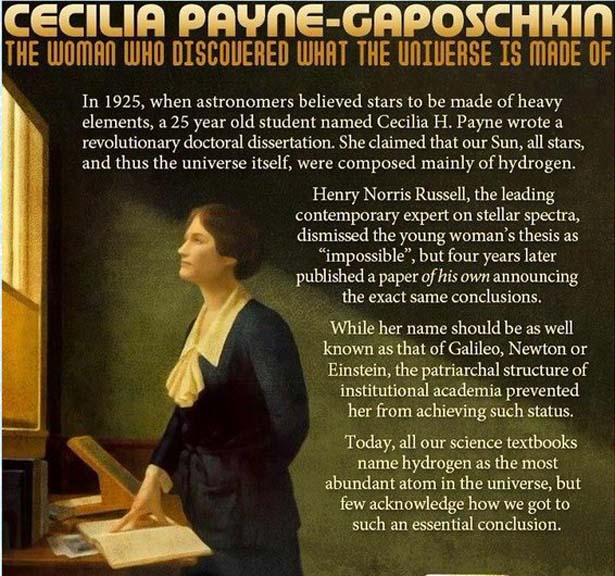
It's an old story which has had so many reruns.
So she came to the states.
But coming here didn't solve her main problem... not having a dick.
So now she's cool, right?
Nice thesis, make me a sandwich. Gotta keep them bitches in their place, you know. :mad:
It's an old story which has had so many reruns.
She attended St Paul's Girls' School. In 1919, she won a scholarship to Newnham College, Cambridge University, where she read botany, physics, and chemistry. Here, she attended a lecture by Arthur Eddington on his 1919 expedition to the island of Principe in the Gulf of Guinea off the west coast of Africa to observe and photograph the stars near a solar eclipse as a test of Einstein's general theory of relativity. This sparked her interest in astronomy. She completed her studies, but was not awarded a degree because of her sex; Cambridge did not grant degrees to women until 1948.
So she came to the states.
Payne realized that her only career option in the U.K. was to become a teacher, so she looked for grants that would enable her to move to the United States. After being introduced to Harlow Shapley, the Director of the Harvard College Observatory, who had just begun a graduate program in astronomy, she left England in 1923. This was made possible by a fellowship to encourage women to study at the observatory. The first student on the fellowship was Adelaide Ames (1922) and the second was Payne.
But coming here didn't solve her main problem... not having a dick.
Shapley persuaded Payne to write a doctoral dissertation, and so in 1925 she became the first person to earn a Ph.D. in astronomy from Radcliffe College (now part of Harvard). Her thesis was "Stellar Atmospheres, A Contribution to the Observational Study of High Temperature in the Reversing Layers of Stars". Astronomers Otto Struve and Velta Zebergs called it "undoubtedly the most brilliant Ph.D. thesis ever written in astronomy".
So now she's cool, right?
When Payne's dissertation was reviewed, astronomer Henry Norris Russell dissuaded her from presenting her conclusion that the composition of the Sun was predominantly hydrogen and thus very different from that of the Earth, as it contradicted the accepted wisdom at the time. However, he changed his mind four years later after having derived the same result by different means and publishing it. Although he acknowledged her work briefly in his paper, Russell was nevertheless often given credit for the discovery even after Payne's work was accepted.
Nice thesis, make me a sandwich. Gotta keep them bitches in their place, you know. :mad: