March 7th Steam's up!
On 3 July 1938, the A4 class locomotive Mallard raced down Stoke Bank at 126mph to set a new steam locomotive world speed record. That record still stands.
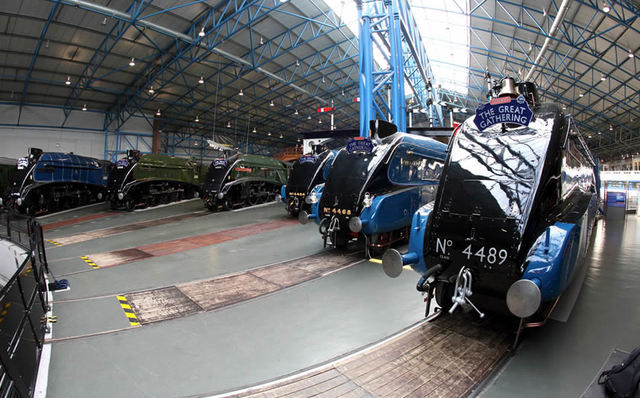
All six surviving A4s came together during 2013/14, in an event organised by the National Railway Museum, to celebrate the 75th anniversary of the record.
Participating locos were:
Mallard
Sir Nigel Gresley
Bittern
Dwight D Eisenhower
Dominion of Canada
Union of South Africa
Mallard 75
Google Images

They were noisy, dirty, dangerous, high maintenance, temperamental, expensive, beautiful contraptions. Oh god, I love 'em. :joylove:
They were noisy, dirty, dangerous, high maintenance, temperamental, expensive, beautiful contraptions. Oh god, I love 'em. :joylove:
... and driving one at 126mph no doubt tested one's testicular fortitude.:eek:
The engineer had 26 years experience and a reputation for taking "calculated risks".
They are beautiful and awesome. I read the captions, and I challenge one of the statements that the streamlining of the engine made it possible to reach the high speeds. I think the streamlining of the engine, which is beautiful, makes a trifling contribution to the high speed of the locomotive. I do think the huge drive wheels were a major factor, as much as the proportionally huge balls as previously noted. I wonder what the run-out room was like (and how long was the train that made the record run) with no drag parachute to soak up the momentum.
True ballz of steel , and stream lining the engine could ABSOLUTELY make a difference , may be small but a difference none the less ,
V look at the Golf ball dimpleing the caused drag or the rear vent on the olympic speed skaters just recently in the olympics
The test train consisted of three of the "Coronation" twin sets, plus the dynamometer car, seven vehicles in all weighing 240 tons."
From milepost 100, speeds at the end of each successive mile were 87½, 96½, 104, 107, 111½, 116, 119 m.p.h. (milepost 93), and then, at the ensuing half-miles, 120¾, 122½, 123, 124¼ and finally 125 m.p.h. at milepost 90¼, while the dynamometer record for a very short distance revealed the tremendous maximum of 126 m.p.h., the figure usually quoted, and at which the 6 ft. 8 in. driving wheels were doing more than 500 revolutions a minute. All this was at 40 per cent. cut-off with full regulator, increased between mileposts 94¼ and 93 to 45 per cent. Five miles (posts 94 to 89) were reeled off at an average of 120.4 m.p.h., and speed actually exceeded 120 m.p.h. for three miles continuously (posts 92¾ to 89¾). So the record was secure; Mallard had travelled faster, not only than the L.M.S.R. Coronation, but also than all other steam locomotives in the world whose high speed performances, properly authenticated by a sequence of passing times, are on record.
The test was on a slight down slope, not conducted with any redundancy, hardly what we'd accept as official today. But! it was 1938 and the Germans had set the existing record of 124.5 in 1936. So the Brits pulled a tw, claiming the record and repeating the dubious claim over and over. It WWII had ended differently, it might be challenged. ;)
They claim when Gresley designed the A-4 series he did a lot of wind tunnel sculpting. It was a big departure from previous steam locomotive design and streamlining imperative as speed was one big objective from the start. He wanted to build locomotives to run over 100mph in daily service, although they were rarely called on to do that. But the Mallard was special, this engine got a couple extra tweaks like a double chimney and double
Kylchap blastpipe, for better draughting and exhaust flow at speed. The Kylchap mixes steam with boiler exhaust in four stages to create a jet stream that sucks the exhaust out better at speed.
Those A4s look pretty freaking modern with the slope fronts. Cool.
The competition designed by Sir William Stanier...
Damn, that's quite a metamorphosis. ;)
They were noisy, dirty, dangerous, high maintenance, temperamental, expensive, beautiful contraptions. Oh god, I love 'em. :joylove:
A bit like me, then ;)
Sent by thought transference
We do loves us some Limey.
All the Limeys are beloved by me.
(pulling rank because I've met them)
And we all love you back, Sundae dearest!
Sent by thought transference
As a fully paid up Limey (ask the Inland Revenue) am I required to say anything at this point in the conversation?
Just askin'...
No.
You are a Limey. Not a Limey.
But hey, feel free to love me anyway.
Whutsatnow? Did someone say free love? Did I hear that?
Here's Bittern under way last weekend.
[ATTACH]47067[/ATTACH]
This image is a scan from one of Monday's newspapers. A less than perfect solution but I have been unable to find the same photo on the web. However, I think it's a good picture to conclude the thread.
No wonder they steam away, they couldn't see where they were going. :haha:
Isn't air resistance one of those things that increases exponentially with speed?
Sure, drag increases as the square of speed. If your car takes 100hp to go 100mph, it'll take 400hp to go 200mph, and 900hp to go 300mph.
Shhhhhhhh... don't say horse power, you're baiting for a lecture.
Bear baiting? Yes.
Mastur baiting, certainly.
Horse baiting? Never.
No matter how much we swoon over the steam age, it's gone. Maybe the jet powered
Black Beetle is the way of the future. :haha:

That will be the locomotive for California's Train to Nowhere.
A little more lift and tracks become optional.
No way is that jet-train in the same book as the word 'efficient'.
No, it was a quick way to build a fast train to test if the existing infrastructure could handle fast trains before they sunk a bunch of money into high speed trains.

The reality is our jobs are on the line, in this day and age efficiency is the only was to get the
shareholders off our ass. Our four field agents are using antiquated methods, and the Chinese have
offered to increase productivity 400% over our horseman. We've got to upgrade without losing the
ability to terrify, or we'll all be selling pencils on the corner.
Here's our new shtick...
[COLOR="White"]................... [/COLOR]

Here's one just sitting around waiting for a kind soul to bring a hot cup of coal and a blankie.
To take pity and adopt the forlorn engine. It may however, be a little complicated bringing it home from Hungary. :rolleyes:

Water shmater, Aussies don't care.
Awesome picture. And impressive capture of the action. So many times, in old pictures, the film technology wasn't there yet to have a fast enough shutter speed to freeze the action. I'd expect this to be all blurry, but it's pretty crisp. Good stuff.
Another squirrel, hunter and tree question ...
Would high water getting into the locomotive's workings
increase or decrease the efficiency of the steam engine ?
I don't see how it could increase efficiency.
Water that high would cool the boiler, no?
I don't know a lot about steam tech, but, I wouldn't think you'd want a cool boiler.
Aussies don't care because everything in Australia wants to kill you.
Why not take going out on a train journey when a trip to the dunny is fraught with peril?
Water that high would cool the boiler, no?
I don't know a lot about steam tech, but, I wouldn't think you'd want a cool boiler.
The water is up to the bottom part of the boiler which is where the firebox is located. The steam tubes are above that, and I don't think the water would have much effect on the boiler because by the looks of that bow wave I doubt they plan on spending a whole lot of time in it. I'd be more concerned about the cylinders with their valving and driving rods that turn the wheels. That stuff is what does the work where the [strike] rubber meets the road [/strike] uh... steam power meets the rails, and it's all submerged. Once they save the village, get the medicine to the orphanage, and drive the vandals from fair dinkum shores, the locomotive will need some serious maintenance.
But I could be wrong.
Big MoFo...
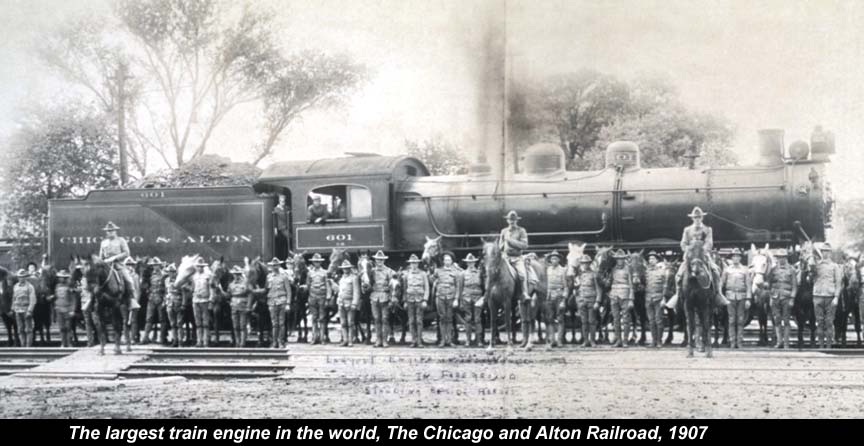
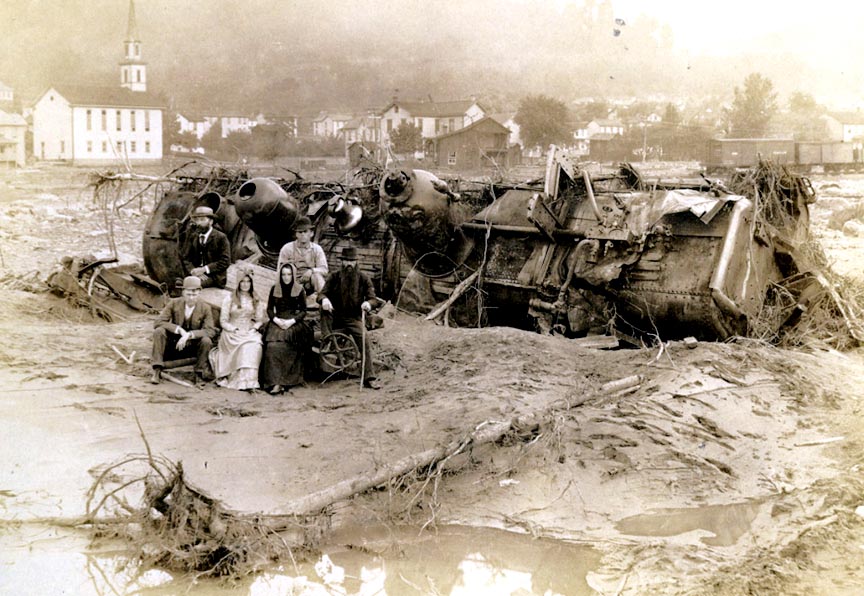
We see all these pictures and stories, both historical(or at least old-timey) and contemporary, of the mighty locomotives overcoming adversity.
I t h I n k I c a n... I think I can... IthinkIcan. But sometimes it can't, like Johnstown, PA, in 1889.
This 1927 exhibit near Baltimore, by the B&O railroad, looks more like something from Rube Goldberg or Doctor Seuss.
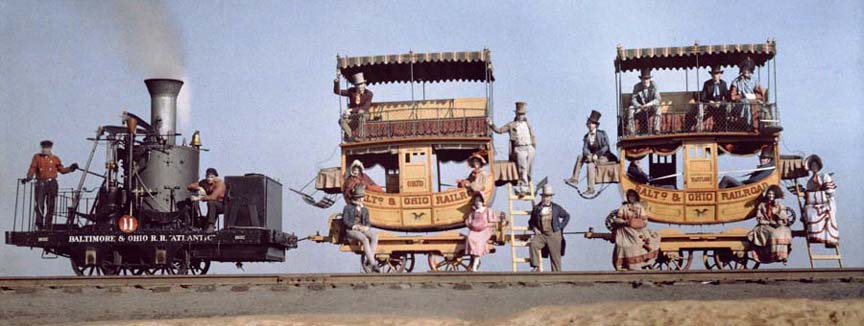
Really, it has to be a joke who would want to ride very fast, or very far, on that contraption?

Well it is real, and they didn't travel either fast or far. The locomotive is an 1892 replica of the 1832 Atlantic, 0-4-0, nicknamed Grasshopper.
Wiki says...
Built at a cost of $4,500, the Atlantic weighed 6.5 tons and had two vertical cylinders. It was commissioned after Davis' entry had won the competition for a steam locomotive design, but the contract was awarded to the inventor of the Tom Thumb; when the five locomotives commissioned failed the contracted delivery, B&O bought out the patents. A few of these were incorporated in the Atlantic by Davis, whether by specification or because Davis wanted them is unclear. The locomotives he delivered before his death in 1835 were the first commercially feasible, sufficiently efficient coal burning steam locomotives produced domestically in the United States and placed into traction service.
B&O built 20 of these engines after the prototype traveled 40 miles, with 50 psi boiler pressure, on one ton of coal. I didn't see a speed, but with 63 hp (47 kW) it couldn't have been that fast, even in relatively flat MD.
Ran across another picture of the Queen's soot belching monsters. ;)

A few days ago I bought a second hand copy of the book 'Terence Cuneo, Railway Painter of the Century'. It includes a large number of his best paintings.
I was especially impressed by this work.

The Mightiest of the Mighty
A Union Pacific ‘Big Boy’ takes on coal and water at Harriman, Wyoming, before tackling the heavy grades of Sherman Hill.
Introduced in 1941, these 4-8-8-4, 594 ton locomotives were the largest ever built and were the equivalent of four conventional engines.
New track had to be laid to cope with their great weight and new turntables for their length.
In all, 201 were built of which six remain today. (1990)
Union Pacific Big Boy
Wiki suggests that 25 of the locos were built and not the 201 quoted in the book.
Terence CuneoG'wan, you ain't foolin' me, that's gotta be a photograph. :mg:
Very simple, want to pull monster loads over big hills, you just build a bigger, badder, locomotive with more grunt. But even with 16 drive wheels, and gigatons of weight on them, the total contact between the wheels and the track is miniscule...infinitesimal. How in hell do they transfer all that grunt?
G'wan, you ain't foolin' me, that's gotta be a photograph. :mg:
Very simple, want to pull monster loads over big hills, you just build a bigger, badder, locomotive with more grunt. But even with 16 drive wheels, and gigatons of weight on them, the total contact between the wheels and the track is miniscule...infinitesimal. How in hell do they transfer all that grunt?
Weight ... the more weight the higher the coefficient of friction on the rails.
Then all you need is the torque to get it started and keep it rolling,
... and occasionally, to stop it when that is needed.
Yes it does, but the contact area to apply that to remains the same. At some point the wheels and/or rail will gall and deteriorate. I did notice the Big Boy has maximum traction at 10mph.