[FONT="Arial"][SIZE="4"]
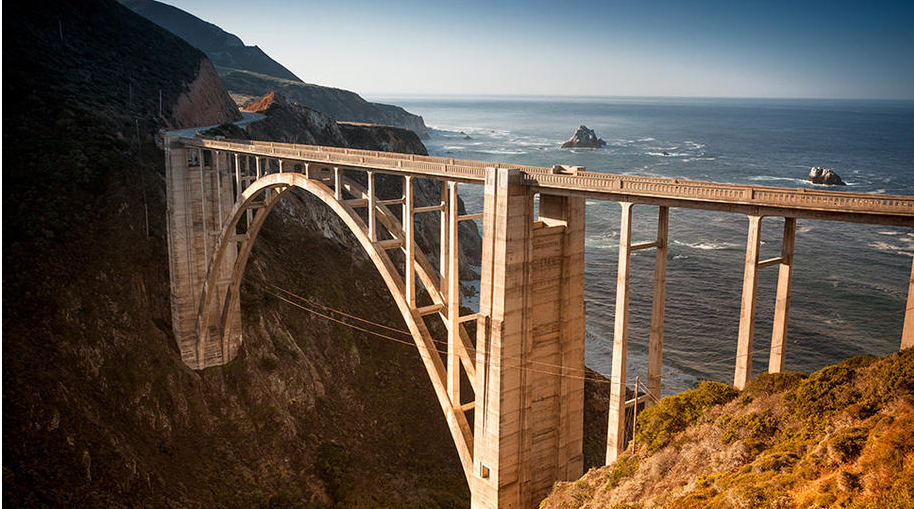
Bixby Bridge was my first bridge-love. I loved driving across this bridge.
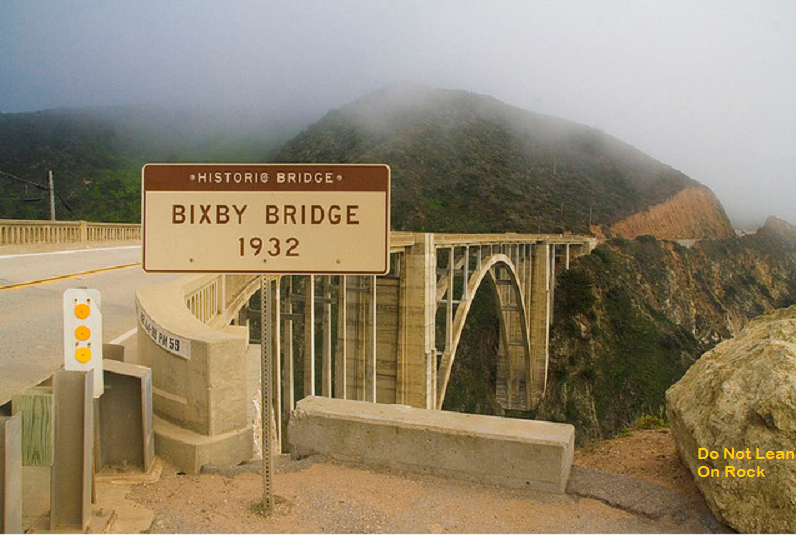
A while back, I told a story about me and my friends out for an evening adventure and coming across this rock that had a sign that said “Do Not Lean On Rock.” Being teens and feeling invincible we had to try to push this rock over the edge. We failed.
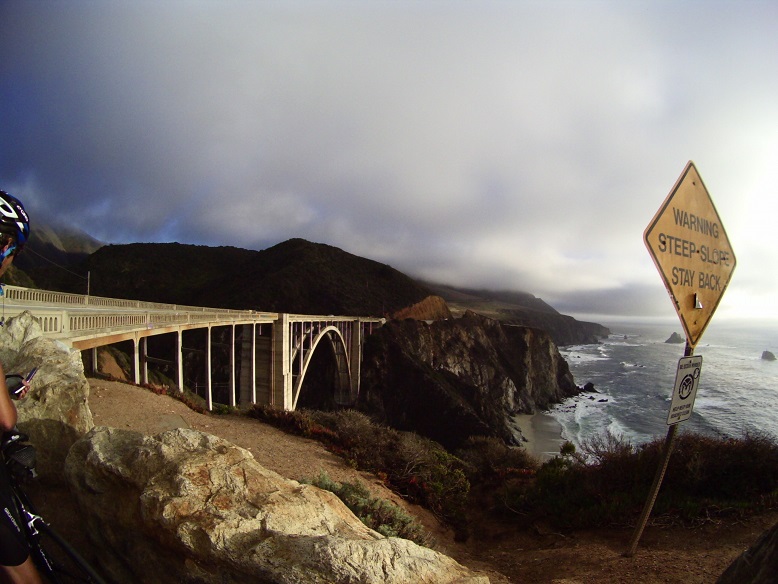
This is a view shows a bit of the path on the other side of the rock. When we were there, there were no other boulders along cliff. Looks like the sign has taken some abuse as well.
Thanks to
The Travel Channel and photographer Paul Giamou of Aurora Photos for the first gorgeous view.
Olasis gets credit for the historical image of the bridge.
Thanks to
Pacific Coast Cycle for a Cause for the biker’s perspective.[/SIZE][/FONT]
'Tis an iconic scene
Although I grew up in LA, this bridge has always symbolized to me
the change-over to better a life style
... going north ;)
A couple years ago I read an article about the seismic retrofit in the 90's, it was very interesting what they did, how they did it, and what constraints were put on the project so they wouldn't spoil the shape so many people love.
The tourists, won't somebody please think of the tourists.;)
I'm picturing Dr David Banner walking slowly across that bridge with his knapsack slung over his shoulder.
The word "spindly" comes to mind.
I'm picturing Dr David Banner walking slowly across that bridge with his knapsack slung over his shoulder.
Don't make him angry. You wouldn't like him when he's angry.
I'm picturing Dr David Banner walking slowly across that bridge with his knapsack slung over his shoulder.
You forgot the piano music.
In surfing about, I came across these 2 pics
One is obviously when the bridge was under construction.
The other was a goof-up of a Google Earth image.
[ATTACH]46271[/ATTACH]
[ATTACH]46272[/ATTACH]
'
You forgot the piano music.
Nah, I was hearing it. Duh nah nah nasaah.....duh NAna naaaa
[youtube]D_cOorXCBiQ[/youtube]
Ahh, what a fabulous construction. I can see why you fell in love with it.
In surfing about, I came across these 2 pics
One is obviously when the bridge was under construction.
The other was a goof-up of a Google Earth image.
I am always amazed and left feeling profound awe when I see the feats of construction being made in a time before our modern equipment and engineering-know-how was developed. Like watching the Golden Gate Bridge get built, Hoover Dam and the like.
It's kinda funny doing seismic retrofit on a bridge that has seen some pretty intense earthquakes and lived to tell. When the Big One hits, will there be enough people left to care about it?
Or, is the Big One all one big myth to create industry where there was none?
We're standing on the shoulders of giants.
<snip>
It's kinda funny doing seismic retrofit on a bridge that has seen
some pretty intense earthquakes and lived to tell.
When the Big One hits, will there be enough people left to care about it?
Or, is the Big One all one big myth to create industry where there was none?
Bixby Bridge is on the Callif/Oregon border, north of the Mendicino fault.
Maybe the Pacific plate is going to slide right on by us in Oregon :ipray:
...and it's the Juan De Fuca Gorda plate that's coming ashore to bite us :eek:
[ATTACH]46283[/ATTACH]
(map from
here)
That's ridiculous. We all know a huge crack is going to open down the San Andreas Fault and everything east is going to slide into the Atlantic and sink.
That's ridiculous. We all know a huge crack is going to open down the San Andreas Fault and everything east is going to slide into the Atlantic and sink.
Before anyone else says it, I AM NOT
THAT CRACK!!!
:D

The amount of material used in the construction was enormous: 300,000 feet of timber were used in the falsework, 4,700 cubic yards of earth and rock had to be excavated, and 45,000 sacks of cement were used. The means of transporting the materials across the canyon came from platforms and slings suspended from a cable 300 feet above the creek. Cement was chosen instead of steel due to material and maintenance costs. The cement came from Davenport, near Santa Cruz, and from San Andreas. The creek below supplied the needed water for the mix.
I wonder how many Redwoods died for that bridge?
The falsework, which was the wooden structure built to shape the arch and form the wet concrete, was one of the outstanding accomplishments of E.C. Panton, the general superintendent of Ward Engineering Co. Credit also went to C.H. Purcell, California state highway engineer, F.W. Panhorst, acting bridge engineer, and I.O. Jahlstrom, resident engineer. Two months were spent building the falsework alone. One of the main difficulties was raising and holding the arch frame, exposed as it was to the high winds. The foundation also had to resist the waves which at times reached its base. Work was halted for a time until the dangers of winter storms passed.
Monterey Historical.I used to motorcycle across it on a fairly regular basis when I lived in Monterey. Great ride, really let the good times roll (yes, I rode a Kawasaki ... GPZ 750 R1).
I had to go across it a bunch of times while working on a sod-roofed house's water filtration system. They had troubles with California Condors tearing up their roof. There were motion triggered, Condor chasing, Rainbirds all over the place. We had to weave around trying to not get pegged by them.
Sorry, Lamplighter, but the bridge is South of Carmel over Bixby Creek. Maybe there's another one up north, but this one is south, between Carmel and Big Sur.
Sexobon said: "I used to motorcycle across it on a fairly regular basis when I lived in Monterey. Great ride, really let the good times roll (yes, I rode a Kawasaki ... GPZ 750 R1). "
Ah, memories. I rode down Hwy 1 to Hearst's Castle (San Simeon) on the back of a motorcycle. Absolutely amazing ride. One of the most beautiful experiences I've had. And to think I rode the whole way without a helmet. It was before such things were insisted upon by all.
xoxoxoBruce said: "I wonder how many Redwoods died for that bridge?"
They may not have used redwoods. Just south of Carmel there is a huge, densely wooded canyon (Palo Canyon) and I'll bet that's where they got the trees.
When we explored the canyon we found signs of long-ago logging, bridges made of whole logs, ruins of cabins, lots of stumps and roads that were at one time clear for driving.
I don't remember what kind of trees were in the canyon . . . maybe they were redwoods, but it seems to me there were other trees in that area.
Just guessing, though.
Here it is in the historical article you quoted.
Large advertisements were placed in The Herald honoring Murphy's contribution. Its trucks were used to haul the Douglas fir from the railroad yards in Monterey to the bridge site and the company also supplied sand and gravel for the concrete from a plant in Big Sur. The road at the time was one-way with hairpin turns, making trips very dangerous for the drivers of large trucks.
So, I was wrong about the Palo Colorado Canyon trees. Wonder what that logging was for then?
Redwood is a very soft wood. Not a lumber of choice for weight bearing, since fir is so much cheaper and stronger. Redwood is used for shingles, sidings, fencing and patios, etc., since it resists rot and bugs, similar to cedar, and inside it's a decorative wood paneling.
I've never seen redwood in the structural wood grade section of the lumber yard.
I've never seen redwood in the structural wood grade section of the lumber yard.
We see it around Monterey all the time. The lumber yards all have whole sections dedicated to it. They usually call it "con heart" for construction heart wood. We pick it for things that we want a little less buggy but don't need fully treated wood. Most of my house is made out of redwood studs. All the siding too.
Recycled Redwood, mostly from beams in demolished buildings, is available in 3 x 8,10,12;
4 x 8,10,12,14;
6 x 8,10,12,14;
8 x 8,10,12;
10 x 10,12;
12 x 12;
larger on request.
