any guitar players or musicians?
Anyone in here is guitar players or string musicians, whom I can ask a question so I wouldn’t have to join a guitar forum?
There are quite a few, the least of whom is our fearless leader of course.
What's the question?
Sure!
I dabble on a six-string, but there are plenty here who have played at least semi-pro. UT slaps a mean bass.
So, don't string us along, but stop fretting, get your pluck up, stick your neck out, and ask away!
(Someone's going to tell me to EAD for that last line!)
My guitar (in its case) fell from the top shelf and hit the ground. The 5th string broke, which I changed out. It feels taunt and sounds okay. While testing out the other strings, I found out the 2nd string is very loose. I turned the tuning peg, but the string was still very loose. I kept on turning until the bridge pin popped out. I put it back in and did it again and the same thing happened again.
My question: Is the string broken somehow? Or is there something else wrong? Or should I just change out the string to save the headache? :p:
I'm assuming that "bridge pin" implies steel-string acoustic?
When you say it's very loose - does it hold tune? is it too loose when brought to tune, or does it not get up to tune?
If it holds tune but is too loose, you want a thinner string by a tiny bit.
If it won't get up to tune, you more likely have a problem with your bridge rather than your string. Make sure the bridge pin is being replaced properly. Honestly, the string should break before the bridge gives out, if the string and bridge are installed properly and its a quality axe. If it won't tune, and the bridge pin is definitely going back in right, you can try replacing the string but I doubt that's the problem - more likely you'll need to replace the bridge pin or even the bridge.
How hard did you push the bridge pin in? Give it a good firm push with a bit of twisting as it goes in.
I know, I know ... that's what she said...
What kind of guitar? Classical? Vinyl or steel strings? And by second, do you mean the B string? Is the little metal loop right up under the pin? Do the pins have grooves?
Sorry to tw you.
I’ve put up some pictures, so hopefully that will explain some more. It’s a classical guitar with vinyl strings. My first response would say it does not hold tune. That’s why I tried to tune it. But now, I’m not so sure anymore. When the string popped out, I did put it back in and gave the pin a good firm push with a twist. It still popped out. And to answer Jim, yes, I do mean the B string. There is no metal loop right up under the pin. There is a metal loop at the end of the 5th string that I replaced.
It’s a classical guitar with vinyl strings.
No, it's not.
Also, you need a new string.
Those little eyelets at the bottoms of fresh strings?
They're what hold the string in place. Much more effectively than that tiny little knot you've tied.
Well, that's what I have. I got a pack of extra strings. The 3 low strings look like what's on the guitar. The 3 high strings are steel strings with knotted ends like the one I left hanging out so y'all can see which string I'm talking about. The envelope says nylon strings so I say I've got nylon strings.
I'm sorry - I didn't mean to be rude! Re-reading it, i'm sorry, it does come off a little abrasive. my bad.
But, those aren't nylon strings on the guitar in the picture, and that isn't a classical guitar. If you bought nylon strings, I can't imagine why there would be steel strings in an envelope marked nylon strings.
A nylon bridge, with strings, looks like this:
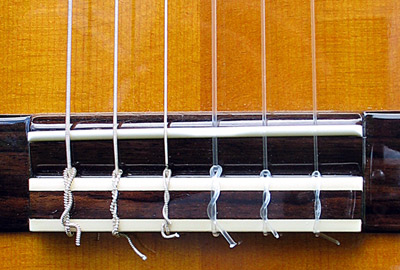
Nylon high strings are clear plastic nylon, not steel like in the photo.
Steel strings look like this:
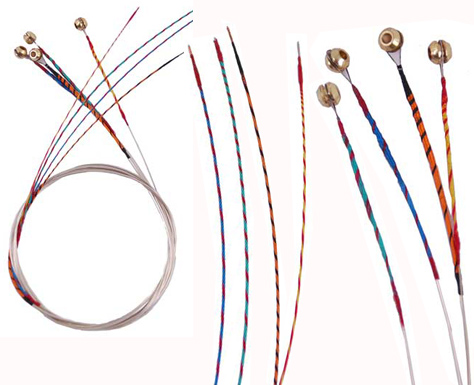
Note the eyelets at the ends. Those go under the bridge pin, to hold in place. My guess is just that the little knot at the end of your trouble string is just slipping through the pin. The eyelets fix that.
If the strings in your photo are just very deceptively sized and coloured nylon strings - well, you have a steel-string guitar, and it would probably both sound better and string properly if you strung it with steel strings.
The guitar itself does not appear to be a typical classical guitar. They generally have no pick guard. The strings that are on it are classical nylon strings, though. There are two types of classical strings.
To start, all of those strings need to be replaced. When you buy them be sure to get the ones with the rings on the ends.
[ATTACH]38884[/ATTACH]
Many are designed to be tied to the bridge end. You don't have that kind of bridge. Those pegs you have are made to use with the 'ball ended' strings like the first ones above.
Martin, Dean Markley, Ernie Ball. should be less than $7 for a pack. buy two. classical string break a lot.
Check you tube for guitar stringing instructions.
I also am unused to classical guitars having bridge pins. That's typically a folk style guitar, ditto on the pick guard. My classical has the type of bridge in Ibram's picture.
The neck also looks more folk-like. A classical neck is wider, and I'm not used to the pearlized insets ... my classical guitar does have some guide marks, but they are on the side of the neck, not on the fretboard. Does that guitar have the steel reinforcing rod in the neck allowing you to use steel strings? Another mark that it's a folk, not a classical. And, finally, is there a pin on the bottom to attach a strap? My classical only has one because I had it added when I was a kid.
[YOUTUBE]xADm84D4Y5I[/YOUTUBE]
I'd never heard of a 'Folk Guitar' per se.... but they seem to be regular acoustic guitars with smaller bodies, strung with classical style strings to make finger picking easier.
I can make out the word Arbor inside there, lola.. is that the manufacturer? I found AN
Arbor Guitar website, but they don't appear to make acoustic guitars at this point, and the logo is different from what I see there
I've never heard of a guitar with a head, neck, and bridge like that being strung with nylon strings.
Make SURE that it's supposed to have nylon strings, or the tension on the neck will be off, which will warp and detune your neck.
folk = non-classical acoustic
right, but there are many sub categories. I have a Martin d28 or 37 or something.... damn, i can never remember. but it's shallower than my other two, lighter, and LOUDER.
My dad used to have a 69 Gibson Jumbo. HUGE big guitar. that one there looks like it might be a shade smaller than a regular guitar. What I found on 'Folk Guitars' said they were smaller, sometimes 3/4 necks. SHorter neck = looser strings = more bending notes.
My little backpacker guitar is a 3/4 neck, and I really like that aspect of it. Might be why it came with nylon strings too, Ib.
Yes, it is an Arbor guitar. This guitar was bought in the early 80's so perhaps it might be the same company. They just no longer make this type of guitar. To be frank, I don't even know what kind of guitar it is. It is also a possibility someone switched out the orginal strings and put the nylon strings in. The extra pack of strings I see in the case has thin steel strings for the strings first 3 or 2 strings. Sorry dont remember names. Damn...virus alert popped up. will continue later.
The guitar itself does not appear to be a typical classical guitar. They generally have no pick guard.
That and the 12th fret on a classical guitar is at the top of the body. I am sure this guitar came with steel strings.
I had this problem myself, all I did was switch that pin with the one on the next biggest string and luckily it worked.
I'm experimenting with a symmetrical drum setup. Toms start at 8" in the middle and proceed in diameter, downward and alternating from left to right (for example, classic "descending fills" can start in the middle and can go in either direction). Each side of the kit has a set of cymbals of equivalent size and function, in the same relative positions.
The main asymmetry is the fact that only my left foot conrols a hi-hat (whereas both feet can play a bass drum note) but I am not $300 interested in correcting that--I do have a mirror-image fixed hi-hat on the right side.
What I am finding is that I have weakness or clumsiness in certain ranges of motion, and I am attacking those areas.
[/non sequitur]
[/non sequitur]
but interesting! Pic?
[/non sequitur]
but interesting! Pic?
Yes, actually.
#1: The symmetrical setup. This is mainly made possible by my main hi-hat being cable-controlled (a remote hi-hat allows the pedal placement to be independant of where the actual cymbals are located). I'm using a 12-inch "power depth" rack tom (from the 1980s) as my left-side "floor" tom.
#2: The symmetrical setup, top (diagrammatic) view.
#3: I was quite proud of this symmetrical hardware configuration. Note that the tom-mounting hardware hangs off the back of the rack, and is arranged in an an arc--allowing the snare drum to be surrounded by toms. I like this kind of placement because the drums are easy to reach.
#4: Last picture is a fairly standard setup with the same drums. Using a 16-inch floor tom here, and a Sabian "Rocktagon" as the ride cymbal.
As a non-drummer, the top arrangement looks much more intuitive and easier to play.
I learned from the most -symmetrical setup that moving the hihats into such an odd and far away position opened up some new playing ideas and approaches. I'm working on a hybrid between the two, but not yet ready to commit to the exact-middle hihat aka Bill Bruford, Danny Carey.
I also learned that having an 8" tom in primary, up-front position is annoying as hell. Kind of one-dimensional, whereas there are about 100 other things I can get out of a 10" in that position.
Basically, all of this is coming from the fact that I am now using a hardware rack, and "floating" instruments over the bass drum. This opens up a whole new approach to setup. I'm in a discovery phase. Fun stuff!
I redid my computer (virus attack) a few days ago but never came back to this thread to thank everyone for your advices. I will buy a new set of strings. My former music teacher (the one who taught me guitar) was probably the one who changed my strings. I'm sure of this because he was the one who picked out my guitar for me. I'm sure not why he did that. Perhaps because nylon strings hurt less than steel strings? Hihi....Anyways.....Thanks again for everyone's expertise. I'm glad to see we have another music question going on. :)
You might need to replace the peg that holds the string in.
I suggest you take the guitar into a guitar/instrument shop and get their advice.