Aug 12, 2010: Prison Tattoos

xoxoxoBruce • Aug 12, 2010 1:14 am
Tattoos are written communication, they convey a message from the wearer, especially tattoos that are visible wearing normal clothing. Sometimes the message is clear, sometimes not, because like writing, there are different "languages" in tattoos. Police and criminologist have long tried to decipher criminal and gang tattoos... even building libraries.

Before cheap cameras and computers, they just saved the tattoos.
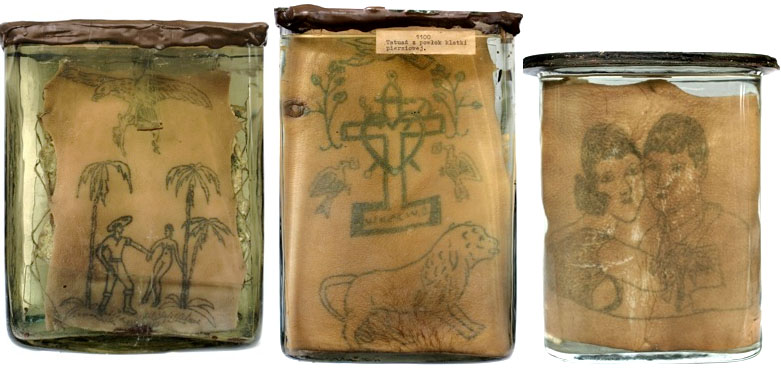
Image

The tattoo collection at the Department of Forensic Medicine at Jagiellonian University in Krakow, Poland consists of 60 objects preserved in formaldehyde, a method devised by one of the experts employed by the Department at the turn of 20th century.
The tattoos were collected from the prisoners of the nearby state penitentiary on Montelupich Street as well as from the deceased on whom autopsies were performed.
The majority of the prison tattoos represent connections between the convicts. Besides gestures and mimics it is a kind of secret code – revealing why 'informative' tattoos appeared on uncovered body parts: face, neck or arms.
The collection was created with a view to deciphering the code – among prisoners known as a 'pattern language'. By looking closely at the prisoners' tattoos, their traits, temper, past, place of residence or the criminal group in which they were involved could be determined.


I suppose they had checked off "Tattoo Donor" on their driver's licenses.
link
Scriveyn • Aug 12, 2010 3:15 am
Just hope the original owners weren't polished off to collect those.
Gravdigr • Aug 12, 2010 4:19 am
Well, I sure hope they didn't remove the tats while the prisoners were still alive.
Rhianne • Aug 12, 2010 4:59 am
I visited Surgeons' Hall, a medical museum in Edinburgh, a few weeks back with my daughter, and among the collection of specimens there were a few jars with tattoos just like the ones above plus a large one of a whole back (it may have been a chest...). Mind you, there were some far less attractive specimens on display.
spudcon • Aug 12, 2010 7:22 am
I wonder if they figured out the code for the "Fuck You" tattoo?
lupin..the..3rd • Aug 12, 2010 7:53 am
Law enforcement does the same thing today. Only with the help of modern technology (digital camera) instead of a scalpel. Any time a prisoner is booked by any federal agency, even just to be transferred from one prison to anther, part of their booking record contains photographs of all tattoo's, as well as prominent scars and other identifying marks. Not a new concept by any means. Just a less messy way of collecting and cataloging them these days. :)
HungLikeJesus • Aug 12, 2010 8:06 am
We need these translated from the original Polish.
classicman • Aug 12, 2010 9:08 am
Thank _ _ _ its not Friday. ewwwwwww
monster • Aug 12, 2010 3:01 pm
what? They're already pickled -tuck in!
Shawnee123 • Aug 12, 2010 3:01 pm
They look almost as bad as most of the tattoos I see these days.
monster • Aug 12, 2010 3:07 pm
Maybe you should start charging more.

What?
Shawnee123 • Aug 12, 2010 3:11 pm
It costs money to be an individual, you know.
Crimson Ghost • Aug 12, 2010 6:56 pm
Yup.

You can be a unique individual, just like everyone else.
jinx • Aug 12, 2010 7:02 pm
Much more interesting than the prison wallet collection...
sweetwater • Aug 12, 2010 9:58 pm
You'd think with all that time to plan an elegant and handsome design the tattoos might demonstrate some degree of artistic endeavor, wouldn't you? :eyebrow:
monster • Aug 12, 2010 11:02 pm
The guy in the first one is saying -look! there's some soap! why don't you pick it up?
HungLikeJesus • Aug 12, 2010 11:46 pm
The one in the middle is from my great-grandfather.
xoxoxoBruce • Aug 12, 2010 11:52 pm
sweetwater;676205 wrote:
You'd think with all that time to plan an elegant and handsome design the tattoos might demonstrate some degree of artistic endeavor, wouldn't you? :eyebrow:
In prison, around 1900, with...
Conditions in prisons allowed only for primitive tools and dangerous chemicals to be used in tattooing. Paper clips, pins, wires, razor blades and pieces of glass were used to puncture the skin and powdered coal, charcoal, burned rubber, cork, pencil refills, ink, watercolours and crayons were used as colour pigments, often mixed with water, urine, soap, cream or fat.
Artistic was moot.
spudcon • Aug 14, 2010 9:46 am
That's more than I needed to know. All those toxins, and mutilation too.