May 11, 2008; Mathematical Quilts

xoxoxoBruce • May 11, 2008 3:47 am
Happy Mother's Day, mothers.

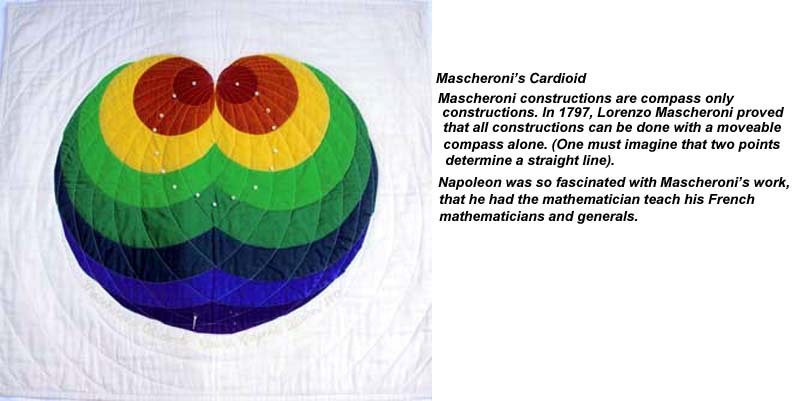
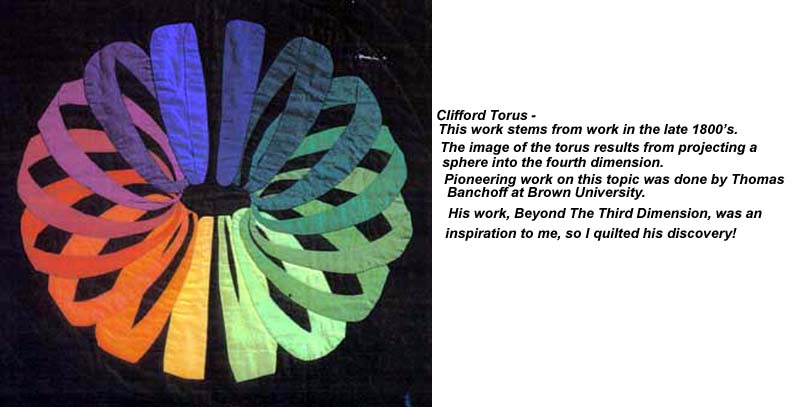
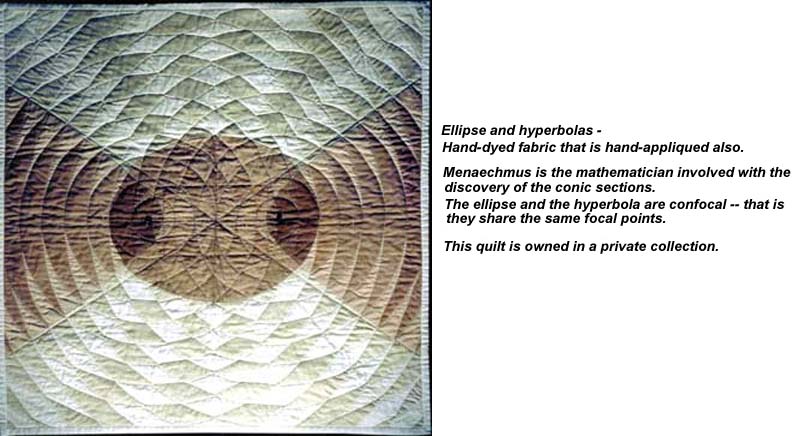
Elaine Krajenke Ellison is a mother. She is also a retired high school math teacher in Indiana, and a quilter. She makes mathematical quilts, many of which are in private collections, but some can be seen publicly at places like the London Science Museum. Here's a small sample....
Image
Image
Image

She also sells note cards with pictures of the quilts and an explanation of their derivation. I bought a set for my retired school teacher Aunt. They're a surprise birthday present, so don't tell anyone.:headshake
spudcon • May 11, 2008 6:07 am
She won't get it outta me, Bruce.
DucksNuts • May 11, 2008 6:47 am
I keep reading Clifford Torus...as Clitoris....think he got much shit at school?
Sundae • May 11, 2008 7:33 am
DucksNuts;452768 wrote:
I keep reading Clifford Torus...as Clitoris....think he got much shit at school?

No, because they didn't have clitorises back then
But I bet no-one would read his resume...

They're lovely Bruce
I don't understand a word of it, but they're very pretty!
Scriveyn • May 12, 2008 7:32 am
quilt erat demonstrandum
sweetwater • May 12, 2008 9:06 am
Beautiful! I wonder if she'll expand her repertoire to include fractals.
Scriveyn • May 12, 2008 10:03 am
sweetwater;452930 wrote:
Beautiful! I wonder if she'll expand her repertoire to include fractals.

She did. The Koch curve and the Sierpinski triangle/square that she has done are fractals.
nephtes • May 12, 2008 3:46 pm
DucksNuts;452768 wrote:
I keep reading Clifford Torus...as Clitoris....think he got much shit at school?


I have nothing but respect for filthy minds, but the Clifford Torus is the shape pictured, not the name of anyone involved. Not sure how it got the name, actually...

http://www.msri.org/about/sgp/jim/geom/r4/torus/rotations/main.html

</pedantry>
Cloud • May 12, 2008 5:27 pm
pretty cool, tho' pretty much all quilts are inherently mathematical anyway--you have to piece together geometric shapes, after all.
DucksNuts • May 12, 2008 7:17 pm
Oh...hahahaha...I just read Clifford Torus and didnt bother with the rest :blush:
SteveDallas • May 12, 2008 7:19 pm
Cloud;453048 wrote:
pretty much all quilts are inherently mathematical anyway

[COLOR="Silver"]shhhhhh!!! don't tell! :D [/COLOR]
Cloud • May 12, 2008 7:32 pm
unless you do applique or crazy quilts, which can be free-form. Pieced quilts, though . . .
Bitman • May 13, 2008 5:28 am
sweetwater;452930 wrote:
I wonder if she'll expand her repertoire to include fractals.


Not very often, they take an infinite amount of material to make.
skysidhe • May 17, 2008 11:25 pm
The clifford Torus is very nice!

I am a math and a seamstress flunkie among other things but I do appreciate the visual.
Imigo Jones • May 18, 2008 9:20 am
Belated Happy Mother's Day!
skysidhe;454683 wrote:
The clifford Torus is very nice!
skysidhe, my mom had one for a long time, but it seemed like she was always taking it back to the dealer for service. A couple years ago she traded it in for a used Escort.
Undertoad • May 18, 2008 9:44 am
:lol:
skysidhe • May 18, 2008 1:12 pm
oh no. Now what manhole did I step in.:blush:
xoxoxoBruce • May 18, 2008 6:31 pm
You didn't, a plane fell on you.
HungLikeJesus • Jun 8, 2008 11:25 pm
[SIZE=2]New Math Tricks: Knitting and Crocheting[/SIZE]


Coral reefs can be crocheted. The atmosphere can be knit. And a stop sign can be folded into a pair of pants.

Welcome to the intersection of math and handicraft. Unexpectedly, handicraft in general, and yarn work in particular, has started to help provide answers to a wide range of mathematical problems. From the way the atmosphere generates weather to the shape of the human brain, knit and crocheted models have provided new insight into the geometry of the natural world.

"Crochet, knitting and other crafts allow people to visualize, recontextualize and develop new problems and answers," said Carolyn Yackel, a mathematician at Mercer University in Georgia.

Another prominent practitioner who uses yarn work, mathematician Hinke Osinga of the University of Bristol, puts it this way: "You can get bogged down in your own standard techniques of doing things, and then someone asks a silly question, and all of a sudden, you see a new way of interpreting things."


From livescience.com.