August 29, 2007: Snowflake under electron microscope

Undertoad • Aug 29, 2007 10:08 pm
Image

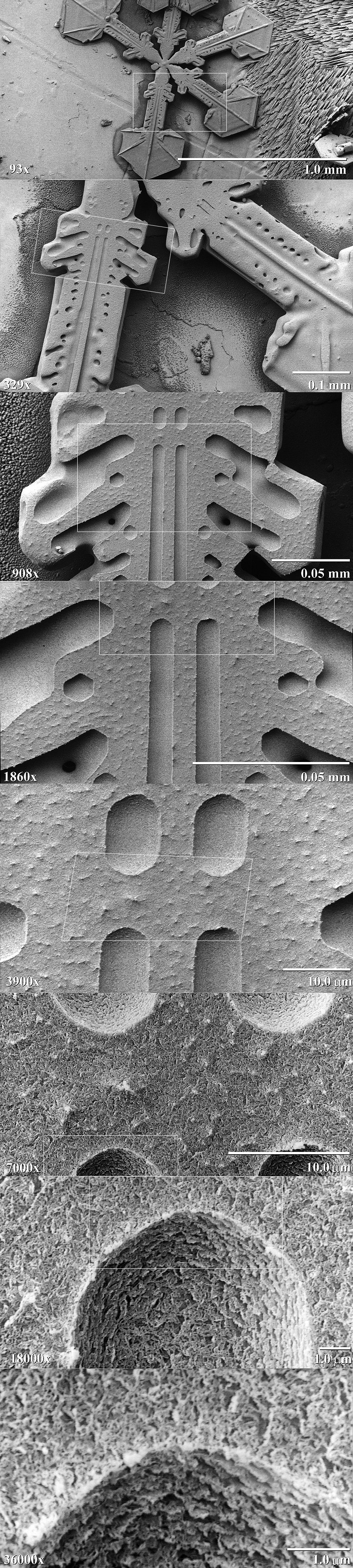
We've seen tons and tons of different snowflakes under an ordinary microscope, but what happens if you look closer?

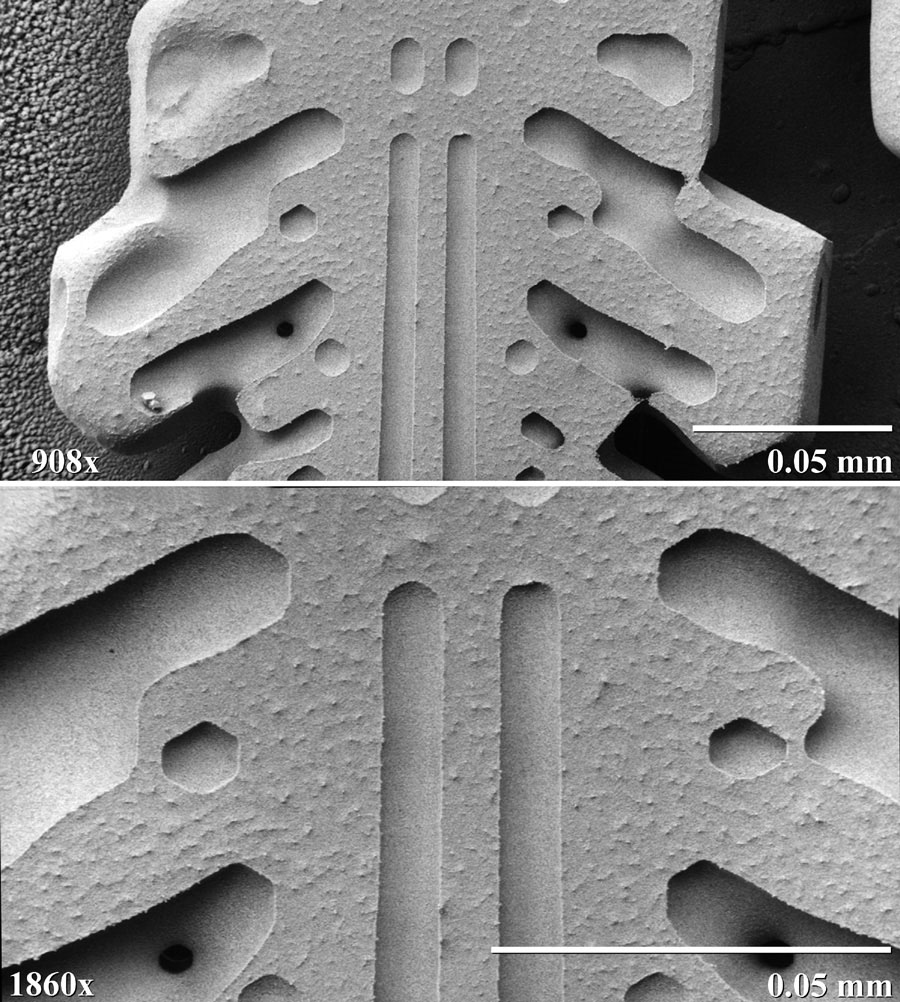
This page has four shots of even closer images of a single flake. In fact, it's part of a single arm from a single six-sided flake.

Another page has put all the magnifications together so you can sort of imagine yourself getting closer and closer to the flake, until it's sort of incomprehensible how close you actually are.

Is it best to consider such things in the midst of summer?
Sheldonrs • Aug 29, 2007 10:25 pm
Sort of loses it's charm this way.
SteveDallas • Aug 29, 2007 10:31 pm
I disagree... it's fascinating.
Flint • Aug 29, 2007 10:32 pm
[SIZE="5"]Fight! Fight! Fight! [/SIZE]
Trilby • Aug 29, 2007 10:48 pm
It looks like a concrete snowflake.

How do they know that no two snowflakes are alike? They can't really check, can they?
Scriveyn • Aug 30, 2007 2:38 am
Brianna;380056 wrote:
It looks like a concrete snowflake. ...


I had been wondering how they did it, beacause electron microscopes can only image objects whose surface is electrically conductive. - So these are platinum coated snowflakes.
Can we make a necklace of them after they're no longer needed for science? :p

(see their explanation here: http://emu.arsusda.gov/snowsite/4100/4100.html)
smurfalicious • Aug 30, 2007 8:36 am
You are not a beautiful and/or unique snowflake.


Very cool pics.
Gravdigr • Aug 30, 2007 9:29 am
I have no snappy and/or smart-ass comment on this subject.
manephelien • Aug 30, 2007 10:22 am
Awesome! I do prefer snowflakes at a normal size or through an amplifying glass or loupe, however.
monster • Aug 30, 2007 10:29 am
Now there's a worthwhile job -platinum-plating snowflakes....

(shouldn't take the piss -the other half is an SEM chap and gold-plates all sorts of weird stuff :rolleyes:)
Coign • Aug 30, 2007 11:44 am
But the fact is if you look long enough, you will find identical "looking" snow flakes.

Wilson A. Bentley, a farmer who was born, lived and died in the small town of Jericho in Vermont was called “The Snowflake Man”. He supported this “all snowflakes are different” theory. Around 1884, at the age of 19, he became the first person to photograph a single ice crystal, by cleverly marrying a microscope to a camera, using an adjustable bellows mechanism. In 1920, the American Meteorological Society elected him to the state of Fellow. They also awarded him their very first research grant, in recognition of his “40 years of extremely patient work” - for which they gave him $25. He continued working in this field until his death in 1931, by which time he had taken 5,381 “photomicrographs” of individual snowflakes. Towards the end of his life, he said that he had “never seen two snowflakes alike”. And so the story arose that all snowflakes are different.

But in 1988, the scientist Nancy Knight (at the National Center for Atmospheric Research in Boulder, Colorado) was studying wispy high altitude cirrus clouds. Her research plane was collecting snowflakes on a chilled glass slide that was coated with a sticky oil. She found two identical (under a microscope, at least) snowflakes in a Wisconsin snowstorm.

They were hollow hexagonal prisms, rather than the classical six-spoked star-shapes – but as far as snowologists are concerned, they counted as snowflakes. But if you want to be pedantic, they probably weren't identical if you were to look at the actual molecules – but at this level, is anything identical?

Since the earth was formed about 4.5 billion years ago, about a million million million million million snowflakes have fallen – but Mr. Bentley made his pronouncement of the cold hard facts after looking at just over 5,000 of them.


http://www.abc.net.au/science/k2/moments/s1784760.htm
runswithknives • Aug 30, 2007 12:39 pm
Leave it to science to make things more complicated...eesh.

Looks cancerous.
HungLikeJesus • Aug 30, 2007 1:15 pm
Luddite!

:)
Grismar • Aug 30, 2007 3:43 pm
Brianna;380056 wrote:
How do they know that no two snowflakes are alike? They can't really check, can they?


The anecdotal evidence offered below shows there's a lot of types at least, prompting a researcher to state there's infinite types and (even more boldly) no two are the same. Knight only proved that there may be subclasses of simple flakes that are likely to have more members (like the plain hexagonal). The poster may be right though, apart from picking at differences at the molecular level, there may even be identical snowflakes at the crystalline level.

It's like saying no two people have the same fingerprints. You can't prove it, but you can show how many variations there can theoretically be. Then you can make an educated guess about how unlikely it is for there to be two or more identical ones.

It's theoretically impossible to prove no two snowflakes are the same. Even if you did have access to all the snowflakes on the planet, there would still be H2O-snowflakes on other planets, in space, in the past, in the future, etc. And besides, it's pointless to prove such a thing.

In fact, it's not what people mean when they say "no two snowflakes are the same". What they're saying is: "the number of possible variations of snowflakes is nearly limitless and most (not all, cue the hexagon) variations seem to have an equal likelihood to occur". But that just doesn't sound like something you'd be telling your kids in the snow :).
xoxoxoBruce • Aug 30, 2007 4:00 pm
Wilson A. Bentley, a farmer who was born, lived and died in the small town of Jericho in Vermont was called “The Snowflake Man”.
So Mr Bentley, for 40 years, struggled, persevered, innovated and froze his nuts off. By dedicating his life to science and contributing to the pool of human knowledge, won the respect and admiration of his peers as well as the scientific community.

Then some chica came along and ruined everything....


Yup, sounds about right.
binky • Aug 30, 2007 5:04 pm
Thank you for the snowflake- it is about 105 degrees here in the California desert, so even the thought of snow is comforting:cool:
middy • Aug 30, 2007 5:08 pm
How do all six arms of the snowflake know to grow into the same shape? That's what I want to know.
glatt • Aug 30, 2007 5:10 pm
middy;380398 wrote:
How do all six arms of the snowflake know to grow into the same shape? That's what I want to know.


I'm pretty sure it's in the genes.
Happy Monkey • Aug 30, 2007 5:26 pm
The shape of the center determines the shape of the arms.
xoxoxoBruce • Aug 30, 2007 6:47 pm
Starfish syndrome.
Beest • Aug 30, 2007 10:59 pm
I usually try and do this at least once each winter, personally I'm going for catching a falling flake, and imaging it without any prep. All that freezing with liquid nitrogen and bombarding with ions might change the structure.
Then again I haven't been successful yet.


Scriveyn;380119 wrote:
I had been wondering how they did it, beacause electron microscopes can only image objects whose surface is electrically conductive. -


Modern (for at least the last ten years) electron microscopes can image non conducting objects by using a low gas pressure in the chamber, incoming beam ionizes the gas around the beam providing a conducting path to dispel charge.

Low beam currents, and accelerating voltages, also help reduce sample charging in the Field emission type SEMs.

I bet you're sorry you asked now :3_eyes:
monster • Aug 30, 2007 11:36 pm
Beest;380571 wrote:
I usually try and do this at least once each winter, personally I'm going for catching a falling flake, and imaging it without any prep. All that freezing with liquid nitrogen and bombarding with ions might change the structure.
Then again I haven't been successful yet.


But you have done some nice pics of a chrysalis. And stuff.
Scriveyn • Aug 31, 2007 4:29 am
Beest;380571 wrote:
... Modern (for at least the last ten years) electron microscopes can image non conducting objects by using a low gas pressure in the chamber, incoming beam ionizes the gas around the beam providing a conducting path to dispel charge.

Low beam currents, and accelerating voltages, also help reduce sample charging in the Field emission type SEMs.

I bet you're sorry you asked now :3_eyes:


Not at all - thanks B. :idea:
paxton • Sep 8, 2007 11:15 pm
middy;380398 wrote:
How do all six arms of the snowflake know to grow into the same shape? That's what I want to know.


http://en.wikipedia.org/wiki/Crystallization