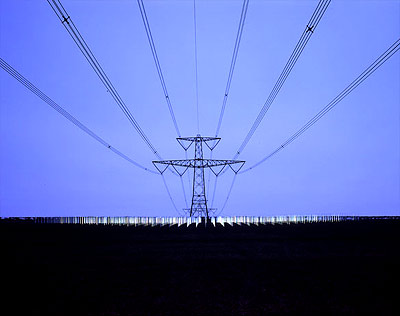
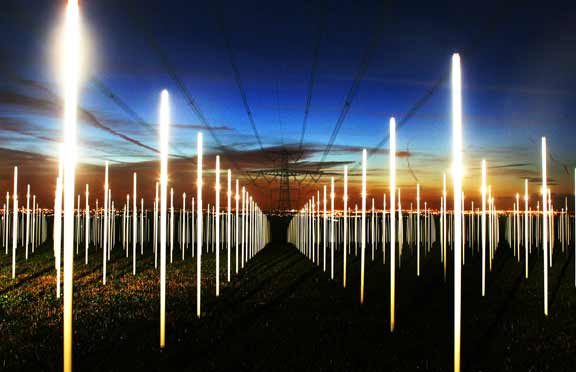
Thanks linknoid, so the power that leaves the generation plant on the high tension lines, divides into two components for the journey. one is the electricity in/on the wire and the other the electromagnetic field surrounding the wire? Rather than the electromagnetic field being created out of thin air, as a side effect, of 100% of the power transmitted along the line?
Sorry for taking so long to reply, I started writing a reply, and got distracted, and just got back to it now. Let me see if I can explain it a bit better.
Think of the electectromagnetic waves like waves in the ocean. It's just an analogy to illustrate a point. The waves themselves are not the water itself, the waves are the motion of the water. The water itself is just the medium that is transferring the energy.
It's the same way with electricity, the electrons are acting as the medium to guide the electromagnetic radiation.
Now in more detail. Imagine an electron sitting there, minding its own business. It has a negative charge, and suddenly along comes an electrical charge that starts pushing it. The energy that goes into the electron weakens the wave, because that energy was transferred to the electron in the form of motion. When an electron is accellerating, it generates a magnetic field, and a changing magnetic field causes other electrons to accelerate, releasing energy from the electron into the surrounding ones, so it decelerates. But now there are more electrons in the "ahead" direction than the "behind" direction, creating an electric field which causes the electrons in front of the wave to be pushed "forward", and the electrons behind to be "pulled" by the now positively charged area in front of them. And the energy propogates.
So now you have these expanding and collapsing waves of magnetism and electric charge. These waves reach far outside the confines of where the electrons are moving, it's just there are no free electrons to play along outside the conductor. If you put another conductor next to that one, the changing magnetic fields will make the electrons in this new conductor move in the same way, they're absorbing energy from that electromagnetic wave.
In fact, if you make the waves strong enough, and you have a something to conduct that electricity just right, you can induce these waves into the other conductor over incredible distances. This discovery led to the invention of the radio, and all the subsequent inventions based on it. Radios are designed to strongly amplify these waves at 1 frequency, and cancel out all the other frequencies. In an AM radio, the sound you here is transmitted by changing the strength of the wave over time (AM is short for Amplitude Modulation, which means it "modulates" the signal using the amplitude of the waves).
Metals tend to have a lot of electrons that are loosly bound, that are free to move around in response to voltages. Other materials tend to hold onto their electrons more closely, so they don't respond to the EM waves as effectively, and when they are forced to by a strong enough voltage, they tend to move in a much less organized manner and convert a lot more of the energy into heat.
However, these waves can travel even without having electrons around to carry them. How that is, I'm not really sure, but they can propogate on their own in complete vacuum. So what are these waves in? They are waves in nothing, that just happen to interact with all these electrically charged particles everything is made of when they get close.
I hope that all made sense.