Mustelidae
From Wikipedia, the free encyclopedia
Jump to:
navigation,
search
iMustelidae 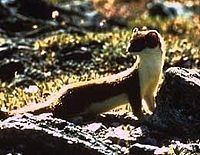
[CENTER]Longtail Weasel[/CENTER]
Scientific classification Kingdom:
Animalia
Phylum:
Chordata
Class:
Mammalia
Order:
Carnivora
Family:
Mustelidae
G. Fischer de Waldheim, 1817 Subfamilies
Lutrinae
Melinae
Mellivorinae
Taxidiinae
Mustelinae
Mustelidae (from Latin
mustela, weasel) is a family of
carnivorous mammals. The family Mustelidae is among the most diverse families in the order Carnivora [
citation needed].
Contents
[
hide]
[LIST]
[*]
1 Variety
[*]
2 Characteristics
[*]
3 Family
[*]
4 See also[/LIST] //
[edit] Variety
Mustelids range from the
Least weasel, not much larger than a mouse, which can live in the high Arctic; to the
wolverine, a 50 pound (23 kg) animal that can dispatch
reindeer, crush bones as thick as the femur of a
moose to get at the marrow, and has been known to drive
bears from kills; to the
ratel, which has a unique
symbiosis with a bird called the
honey guide bird; to the tropical, largely fruit-eating
tayra; to the aquatic
otters. Other mustelids include
mink,
badgers,
weasels,
polecats,
zorilla, and
martens.
Mustelidae is one of the most species-rich families in order
Carnivora, as well as one of the older ones. Mustelid-like forms have existed for the past 40 million years and roughly coincided with the appearance of
rodents.
[edit] Characteristics
Several members of the family are aquatic to varying degrees, ranging from the semi-aquatic mink, the river otters, and the highly aquatic
sea otter. The Sea otter is also the only non-primate mammal known to use a tool while foraging. It uses "anvil" stones to crack open the shellfish that form a significant part of its diet. It is a "
keystone species," keeping its prey populations in balance so some do not outcompete the others and they do not destroy the
kelp in which they live.
Just as otters are adapted to swimming, several groups of
badgers are adapted to digging. Many species of badgers and otters have evolved social groupings.
The
fisher has a unique system to kill
porcupines: it attacks the porcupine's face until the animal is so weak it can be flipped over, giving the fisher access to the porcupine's vulnerable belly. In some areas porcupines form as much as a quarter of the fisher's diet.
The Least weasel, adapted for eating small
rodents such as
mice and
voles, reproduces up to three times a year (unusual for carnivores, who typically reproduce annually) to take advantage of the fluctuations in rodent populations. Because of its small body size and fast metabolism it must eat every few hours to survive, so it runs through multiple cycles of sleep and wakefulness every day.
Many mustelids have scent glands which they use as defense against predators. The most developed of these were found in skunks (
Mephitinae), which were moved into a new family,
Mephitidae, following a convincing paper (
Dragoo and Honeycutt, 1997, Journal of Mammalology, 78(2): 426-443), that somewhat reorganized these two families based on
DNA analyses.
Some mustelids have exquisite furs which have been valuable for many centuries—the mink, the
sable (a type of marten) and the ermine (stoat) are all members of the family. This has led to the hunting of these animals, especially in the past. One species, the
Sea mink (Mustela macrodon) of New England and Canada, was driven to extinction by fur trappers around the same time that the
Passenger pigeon was declining. Its appearance and habits are almost unknown because no complete specimens can be found and no systematic studies were conducted. Today, some mustelids are in trouble for other reasons. The Sea otter, who almost shared the fate of the Sea mink, now risks being destroyed by oil spills and the side effects of overfishing; the
Black-footed ferret, a relative of the
European polecat, suffers from the disappearance of the American
prairie; and the
wolverine is in a long, slow decline because of habitat destruction and persecution.
Ferrets, where they are legal, are kept as pets in many households.
Mongooses and
meerkats bear a lot of resemblance to Mustelidae but belong to a different family -
Herpestidae.
Beavers are semi-aquatic rodents native to
North America and
Europe. They are the only living members of the
family Castoridae, which contains a single
genus,
Castor.
Genetic research has shown the European and North American beaver populations to be distinct
species and that
hybridization is unlikely.
