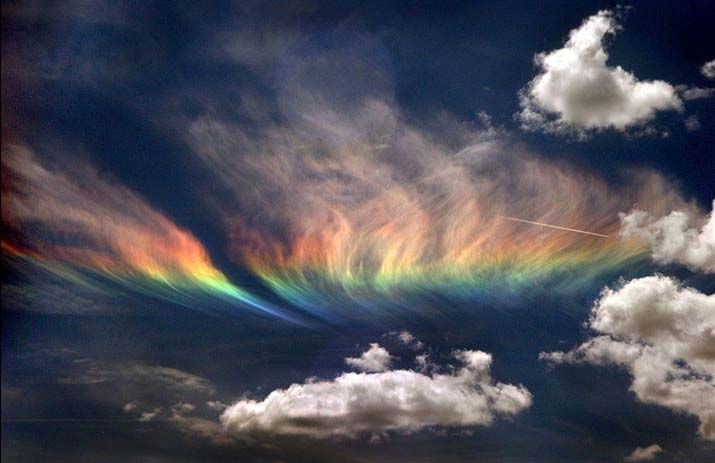
This pic is getting widely circulated - this version from the wire services is probably the best I've noticed, although the best explanation comes from a reader who sent along the
Nat Geo coverage. Says here,
The arc isn't a rainbow in the traditional sense—it is caused by light passing through wispy, high-altitude cirrus clouds. The sight occurs only when the sun is very high in the sky (more than 58° above the horizon). What's more, the hexagonal ice crystals that make up cirrus clouds must be shaped like thick plates with their faces parallel to the ground.
When light enters through a vertical side face of such an ice crystal and leaves from the bottom face, it refracts, or bends, in the same way that light passes through a prism. If a cirrus's crystals are aligned just right, the whole cloud lights up in a spectrum of colors.
The picture appeals to me more than the explanation. Beautiful. I wish I had seen it in person.
You know how everybody just has to find there own image within a cloud...
Well I couldn't resist either:
If God was at a Rainbow Bright and Lloyd Bridges Look a like contest that would be his eyebrow wouldn't it ?
Hi BlueSky_TheMan, did you ingest something that allows you to see those things all the time. :lol:
I wonder what it looked like from the plane?
You can observe this effect to a much lesser degree whenever the sun is high and cirrus is present...if you look through polarized sunglasses. I assume that the polarization only allows the light passing through the properly oriented ice crystals to pass, so you can see a refraction that is otherwise masked by glare.
the ice crystals dont have to be lined up just right. they just need to be random. theres enough of them so a percentage of them would be lined up at any one time. but if they were ALL lined up, well, in the immortal words of Keanu Reeves - "woah"
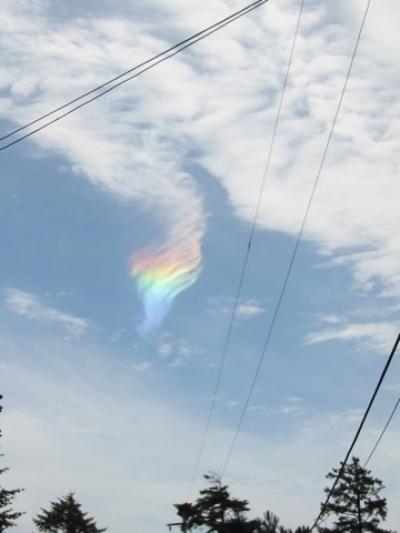 I thought that looked familiar.
Way too many Iotd's for me :yeldead:
Hi BlueSky_TheMan, did you ingest something that allows you to see those things all the time. :lol:
I wonder what it looked like from the plane?
I can neither confirm or deny that I have ingested the afore-mentioned something, but my guess about the view from the plane would be:
This picture was taken in New Zealand, the other day. :eek:
I found a while site full of
this stuff!
Beautiful, who needs drugs!
Shame it was the last thing the photographer saw before the bus hit him.
When light enters through a vertical side face of such an ice crystal and leaves from the bottom face, it refracts, or bends, in the same way that light passes through a prism.
Actually, the breaking up of white light into its component colors is called
dispersion. Refraction is something different.
How dare you question National Geographic (genuflect) ya scurvy cur.:boxers:
From
WikipediaRefraction is also responsible for rainbows and for the splitting of white light into a rainbow-spectrum as it passes through a glass prism. Glass has a higher refractive index than air and the different frequencies of light travel at different speeds (dispersion), causing them to be refracted at different angles, so that you can see them. The different frequencies correspond to different colours observed.
While refraction allows for beautiful phenomena such as rainbows it may also produce peculiar optical phenomena, such as mirages and Fata Morgana. These are caused by the change of the refractive index of air with temperature.
Dispersion
In optics, dispersion is a phenomenon that causes the separation of a wave into spectral components with different wavelengths, due to a dependence of the wave's speed on its wavelength.
Refraction
Refraction is the change in direction of a wave due to a change in its velocity. This is most commonly seen when a wave passes from one medium to another.
I'll grant you:
Refraction is also responsible for rainbows and for the splitting of white light into a rainbow-spectrum as it passes through a glass prism. Glass has a higher refractive index than air and the different frequencies of light travel at different speeds (dispersion), causing them to be refracted at different angles, so that you can see them. The different frequencies correspond to different colours observed.
Dispersion may need refraction to take place, but not all refraction breaks white light into its component colors. If it did, anyone who wears glasses would always be looking at rainbows.:rainfro:
After the dispersion, traveling through a medium like glass, if it didn't refract would it recombine to white light again?:confused: